New School Year, Bigger Challenges:

How Martial Arts Can Help Children Build Real Confidence

September brings new beginnings.

For some children, it’s simply moving up another school year.

For others, it’s a much bigger change.

Primary school becomes secondary school.

Familiar teachers are replaced by several different teachers.

Friendship groups change.

The school becomes bigger.

Homework increases.

Expectations increase.

Children are expected to become more independent and take greater responsibility for themselves.

For a confident child, these changes can be exciting.

For a child who already doubts themselves, they can feel enormous.

This month at SWKA, we’ve been focusing on confidence.

But confidence isn’t something we can simply give a child by repeatedly telling them:

“Be confident.”

Real confidence develops when children experience challenges, discover they can cope with them and gradually build evidence that says:

“I can do this.”

That’s one of the reasons martial arts can become such a valuable long-term journey for a young person.

The Jump From Primary to Secondary School Is Huge

Think about school from a child’s perspective.

At primary school, they may have spent years in a relatively familiar environment.

They know the building.

They know the teachers.

They know their classmates.

They understand the routine.

Then secondary school arrives.

Suddenly they may be travelling further.

Finding different classrooms.

Meeting hundreds of new students.

Remembering equipment.

Managing a timetable.

Completing more homework.

Dealing with older pupils.

Making new friends.

And taking much more responsibility for themselves.

Even children who appear confident can find that transition difficult.

And although the primary-to-secondary transition is perhaps the most obvious example, children face smaller versions of it every year.

Moving into a new class.

Different teachers.

More difficult work.

New expectations.

Growing independence.

Confidence becomes increasingly important.

Confidence Isn’t Being the Loudest Child in the Room

This is something I think we sometimes misunderstand.

A confident child doesn’t necessarily need to be loud.

They don’t have to be the person with their hand up for every question.

And a quieter or more introverted child doesn’t need their personality “fixed”.

Real confidence can be much quieter.

It might mean:

Walking into a new classroom despite feeling nervous.

Asking a teacher for help.

Introducing yourself to somebody new.

Putting your hand up occasionally.

Trying something you might get wrong.

Standing up for yourself appropriately.

Coping when something doesn’t go to plan.

That’s the kind of confidence that can make a real difference as children grow.

So How Does Martial Arts Actually Build Confidence?

Not through one lesson.

And not simply because an instructor tells a child they’re confident.

It happens through hundreds of small experiences.

Imagine a child attending their first martial arts class.

They may not know anybody.

They stand near Mum or Dad.

They’re unsure where to go.

Then somebody welcomes them.

They join in.

They’re partnered with another student.

They learn something.

The class finishes.

They survived something that initially felt uncomfortable.

Next week, the room is slightly more familiar.

A few weeks later, they know people’s names.

Eventually, they walk through the door without worrying about it.

That might not look like a dramatic transformation.

But every step is teaching the child:

“New situations can feel uncomfortable, and I can still cope with them.”

That’s an incredibly useful lesson when you’re walking into a new school or classroom.

Learning to Speak to Different People

School requires children to communicate with lots of different people.

Friends.

Teachers.

Older students.

People they don’t know.

Martial arts provides regular opportunities to practise social interaction in a structured environment.

A child may work with one partner and then another.

They may need to ask a question.

Listen to instructions.

Communicate while practising a technique.

Encourage their partner.

Eventually they may help a newer student.

For a child who finds social situations difficult, having something specific to do together can make interaction easier.

They don’t necessarily have to think:

“How do I make friends?”

They start by simply training alongside somebody.

Over time, conversations and friendships can develop naturally.

Confidence Comes From Getting Things Wrong

This might sound strange.

But making mistakes can be one of the best ways to develop confidence.

A child attempts a technique.

It doesn’t work.

Nothing terrible happens.

They try again.

Still not right.

An instructor helps.

Their partner helps.

They practise.

Eventually it improves.

The child learns something far more valuable than the technique itself:

Getting something wrong isn’t the same as failing.

Imagine carrying that mindset into school.

A maths question is difficult.

An assignment doesn’t go perfectly.

They get something wrong in class.

Instead of immediately thinking:

“I’m stupid.”

or:

“I can’t do this.”

they have another possible response:

“I don’t understand it yet. What do I need to do differently?”

That’s confidence and resilience working together.

Gradings Teach Children to Deal With Nerves

Confidence doesn’t mean never feeling nervous.

Adults sometimes forget this.

We still get nervous before interviews, presentations, difficult conversations and important events.

The useful skill isn’t eliminating nerves.

It’s learning how to function despite them.

Martial arts gradings provide opportunities to practise exactly that.

A student knows the grading is coming.

They prepare.

They practise.

They may worry beforehand.

Then the day arrives.

They have to perform.

Afterwards, whatever the outcome, they have experienced facing something that mattered to them.

Repeated experiences like this can gradually teach:

“I can feel nervous and still do it.”

That’s a lesson children can take into tests, exams, performances, interviews and many other situations later in life.

Moving Up the Martial Arts Journey Brings Greater Expectations Too

There’s an interesting similarity between school and martial arts.

As children progress, more is expected of them.

A beginner isn’t expected to behave like an experienced student.

But gradually they learn more.

They become more independent.

They take greater responsibility.

They may be expected to remember more.

Eventually, newer students begin looking to them for help.

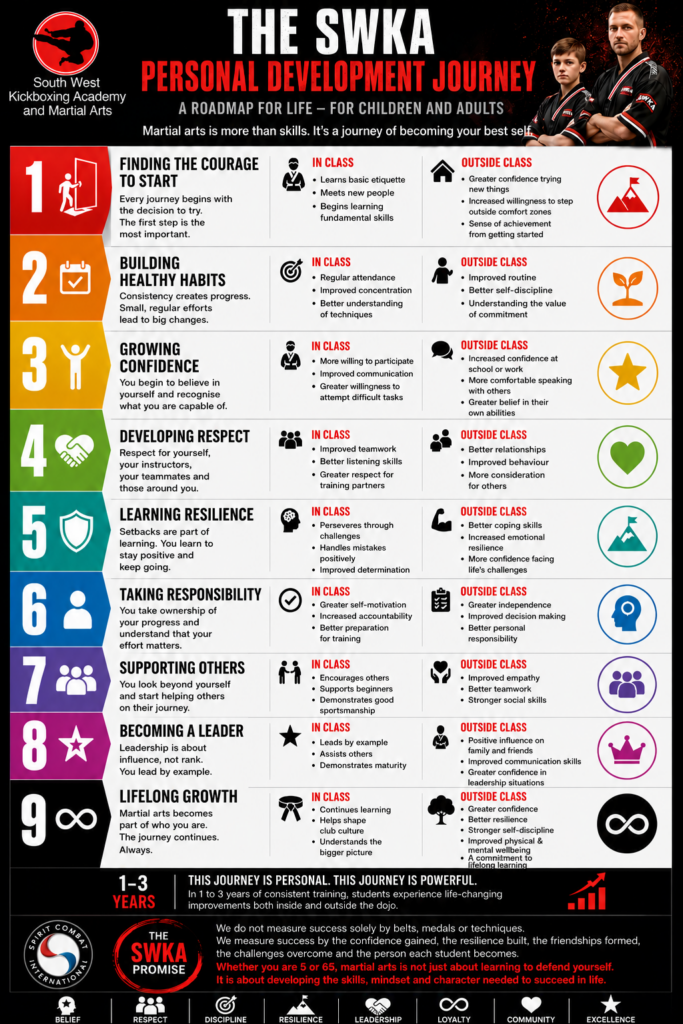
This is part of our SWKA 9-Stage Martial Arts Journey.

Students begin by having the courage to start.

Then they develop confidence.

They learn respect.

Discipline develops.

They experience setbacks and build resilience.

They become part of the community.

Later, responsibility and leadership begin to emerge.

Just like moving through school, each stage brings new challenges.

And each challenge creates another opportunity to grow.

The Nervous Child Can Eventually Become the Person Helping Someone Else

This is one of the transformations I most enjoy seeing.

A child starts martial arts nervous and unsure.

Someone helps them.

Months pass.

Perhaps years pass.

Then another nervous child walks through the door.

Suddenly the original student isn’t the beginner anymore.

They recognise what the new student is feeling.

They say hello.

They offer to work with them.

They help them with a technique.

Think about what’s happened.

The child who once lacked confidence has become confident enough to make somebody else feel more confident.

That’s much bigger than learning another punch, kick or martial arts technique.

Neurodiverse Children May Experience These Changes Differently

There isn’t one type of confident child.

And there certainly isn’t one route to confidence.

Some neurodiverse children may find changes in routine, unfamiliar environments or social situations particularly challenging.

Others may thrive on change.

Every child is different.

For some children, martial arts can provide a useful combination of structure and gradual challenge.

There is a familiar class.

A familiar instructor.

Clear activities.

Skills that can be broken into smaller stages.

Repetition.

Goals.

Familiar students.

Within that structure, small challenges can gradually be introduced.

Working with somebody different.

Learning a new technique.

Preparing for a grading.

Helping another student.

Confidence can develop at the individual’s pace rather than expecting every child to suddenly become outgoing.

Confidence Built in Martial Arts Doesn’t Have to Stay in Martial Arts

This is where the long-term value becomes particularly interesting.

A child doesn’t have separate confidence for every part of their life.

Experiences begin shaping how they see themselves.

The child who repeatedly experiences:

“I was nervous, but I did it.”

“I couldn’t do that, but I learned.”

“I didn’t know anybody, but I made friends.”

“I made a mistake, but I recovered.”

“Someone helped me, and now I can help somebody else.”

is gradually building a story about themselves.

I can cope.

I can learn.

I can improve.

I can ask for help.

I can deal with challenges.

That’s the kind of confidence we want students to take outside the training hall.

Think About Where They Could Be in Five Years

When choosing an activity for a child, it’s easy to think about the immediate future.

Will they enjoy tonight?

Will they like the instructor?

Will they make friends?

Those things matter.

But I think there’s another question worth asking:

Who could this activity help my child become?

Imagine a child beginning martial arts at 10.

By 15, they could have spent five years practising:

Confidence.

Resilience.

Discipline.

Communication.

Responsibility.

Working with different people.

Dealing with nerves.

Learning from mistakes.

Helping others.

Leadership.

Those qualities can become increasingly important as school becomes harder and adulthood gets closer.

That’s why we don’t see martial arts as something children simply attend for a few weeks.

The real value is in the journey.

A New School Year Can Be a New Beginning

If your child has recently started secondary school, moved into a new year or is finding the increased expectations difficult, remember that confidence doesn’t need to appear overnight.

It can be built.

One experience at a time.

One challenge at a time.

One success at a time.

At SWKA, we offer:

  • Mixed Age Kickboxing in Tavistock for ages 7+
  • Children’s Spirit Combat (Aiki-Jitsu) in Bere Alston

And as students grow older, there is a continuing pathway through our mixed-age Kickboxing and Adult Spirit Combat classes.

Complete beginners are welcome.

Your child doesn’t need to arrive confident.

They don’t need previous martial arts experience.

They don’t need to be the loudest, sportiest or most outgoing child in the room.

They simply need somewhere safe to start developing.

Because confidence isn’t something children either have or don’t have.

It’s something that can grow through the experiences they have.

And the nervous child beginning their journey today could be the confident teenager helping somebody else through theirs a few years from now.

Am I Too Old to Start Martial Arts?

Why Starting Later in Life Could Be One of Your Best Decisions

“I’d love to try martial arts, but I’m probably too old now.”

It’s something I’ve heard many times.

Sometimes it’s followed by:

“I should have started when I was younger.”

“I’m nowhere near fit enough.”

“I’d make a fool of myself.”

“Everyone else will know what they’re doing.”

For many adults, the biggest thing stopping them from starting martial arts isn’t their age.

It’s the belief that they should already be younger, fitter, more flexible or more confident before they walk through the door.

After 24 years training in martial arts and teaching since 2005, I’d argue almost the opposite.

You don’t need to become ready for martial arts before you start.

Starting is how you begin becoming ready.

Adults Become Very Good at Staying Comfortable

As children, we’re beginners constantly.

We learn to swim.

Ride bicycles.

Try sports.

Start new subjects.

Meet new people.

And we’re expected to get things wrong.

Adulthood can be very different.

We become competent at our jobs.

Develop routines.

Spend time with people we know.

And gradually we can stop doing things we’re not already good at.

Then you walk into your first martial arts class.

Suddenly you’re a beginner again.

Your hands and feet don’t necessarily cooperate.

Someone demonstrates a movement that looks straightforward.

You try it.

It isn’t.

And that’s a good thing.

Because you’re learning again.

Your First Goal Isn’t to Be Good

Nobody sensible expects a beginner to arrive knowing martial arts.

Your first achievement is simply turning up.

Then you learn your first movements.

Your first combinations.

Your first techniques.

Perhaps you struggle to remember everything.

That’s normal.

The following week, something feels slightly more familiar.

A few weeks later, you realise you don’t have to think quite so hard about something that initially felt impossible.

That’s progress.

And progress is addictive in a way that simply repeating the same exercise often isn’t.

“But I’m Not Fit Enough”

This is one of the strangest barriers adults create for themselves.

People think:

“I need to get fit before I start an activity that could help me become fitter.”

You don’t need to arrive at your destination before beginning the journey.

Fitness develops through training.

At first you may tire more quickly.

Your coordination might need work.

Your mobility may not be what it once was.

That’s your starting point.

Over time, regular martial arts training can help you work on:

  • Fitness
  • Coordination
  • Balance
  • Mobility
  • Strength
  • Movement
  • Body awareness

The important comparison isn’t you against the fittest person in the room.

It’s you today compared with you six months from now.

Something Happens After the First Few Months

Initially, everything is new.

You’re concentrating on where your feet go.

Trying to remember techniques.

Learning names.

Working out how classes operate.

Then gradually the unfamiliar becomes familiar.

You know where you’re going.

You recognise people.

People recognise you.

Someone asks how your week’s been.

You have preferred training partners.

You start looking forward to seeing people.

Without deliberately trying to “make friends”, you’ve started becoming part of a community.

For adults, that’s more valuable than many people realise.

Making Friends as an Adult Isn’t Easy

When you’re young, social opportunities are everywhere.

School.

College.

University.

Sports.

As adults, life often becomes:

Work.

Home.

Family.

Responsibilities.

Repeat.

Even people surrounded by colleagues can have surprisingly few opportunities to form new friendships.

Martial arts gives people a shared interest immediately.

You don’t need to walk into a room and make small talk with strangers.

You’re there to train.

You work together.

You help each other.

You laugh when things go wrong.

Relationships develop naturally around the activity.

Months later, the people who were strangers on your first evening aren’t strangers anymore.

You Get an Hour Where Work Isn’t in Charge

Another benefit adults often don’t anticipate is simply having somewhere they need to be mentally present.

You can’t spend the entire class thinking about tomorrow’s emails while trying to remember a technique.

For that hour, your attention shifts.

Work isn’t the priority.

The phone isn’t the priority.

Household jobs aren’t the priority.

You are learning.

Moving.

Thinking.

Interacting with other people.

For someone whose brain spends most of the day jumping between responsibilities, that change of focus can be incredibly refreshing.

Confidence Can Change Too

Adult confidence is interesting.

Someone can be extremely confident professionally and still feel uncomfortable trying something new.

Martial arts puts you back into situations where you don’t automatically know the answer.

You try something.

Get it wrong.

Try again.

Improve.

Eventually you achieve something that seemed difficult several months earlier.

That creates genuine confidence.

Not:

“I’m good at everything.”

But:

“I can learn things I don’t know how to do yet.”

That’s a powerful belief at any age.

Then You Reach a Point Where You’re No Longer the New Person

This is one of my favourite parts of the martial arts journey.

A new beginner arrives.

They look slightly nervous.

They’re trying to follow what everyone else is doing.

And suddenly you realise:

That used to be me.

Perhaps you’re partnered with them.

You help them with something.

You tell them not to worry.

You remember struggling with exactly the same technique.

The person who once worried about being the worst person in the room has become the person reassuring somebody else.

That’s transformation.

One Year Can Become Several Years

This is where the real benefits begin accumulating.

Imagine spending several years regularly:

  • Moving your body
  • Learning new skills
  • Challenging yourself
  • Meeting people
  • Overcoming frustration
  • Working towards gradings
  • Developing discipline
  • Helping others
  • Building confidence

You don’t experience all of those benefits after four lessons.

They accumulate.

This is why at SWKA we use our 9-Stage Martial Arts Journey.

We’re interested in what happens to the person over the long term, not simply which technique they learn next.

The nervous beginner can develop confidence.

Confidence develops into greater independence.

Experience creates opportunities to help others.

Helping others develops responsibility and leadership.

Eventually, you’re not simply someone who attends martial arts.

You’ve become a martial artist.

What About Starting in Your 40s or 50s?

There’s no rule saying meaningful personal development has to stop at 30.

If you’re 45 and spend the next five years training, you’ll be 50.

If you don’t start, you’ll still be 50.

The difference is what could happen during those five years.

How much fitter could you become?

What skills could you learn?

Who might you meet?

How much more confident could you feel?

What might you achieve that currently seems impossible?

Age changes how we train.

It doesn’t automatically remove our ability to learn.

You Don’t Have to Want to Fight

Another misconception is that adults join martial arts because they want to fight.

Most don’t.

People start for all sorts of reasons.

They want to become fitter.

Learn practical skills.

Build confidence.

Reduce stress.

Meet people.

Challenge themselves.

Have something that’s theirs.

Some simply watched martial arts when they were younger and always thought:

“I’d love to try that one day.”

Perhaps “one day” has arrived.

What Could Your Next Few Years Look Like?

Instead of asking:

“Am I too old to start martial arts?”

Try asking:

“What could happen if I started now?”

Six months from now you could be fitter and more confident.

A year from now you could have achieved your first few gradings.

Several years from now you could be the experienced student helping somebody through their first class.

Or you could still be thinking:

“I’ve always wanted to try martial arts.”

Only one of those possibilities requires taking the first step.

Start Where You Are

At SWKA, you don’t need previous experience.

You don’t need to already be fit.

And you certainly don’t need to have started martial arts as a child.

We offer:

  • Mixed Age Kickboxing in Tavistock – ages 7+
  • Adult Spirit Combat (Aiki-Jitsu) in Bere Alston – ages 14+
  • Children’s Spirit Combat (Aiki-Jitsu) in Bere Alston

Our classes are about long-term development: martial arts skills, fitness, confidence, resilience, friendships, discipline and becoming more capable over time.

If you’ve been thinking about trying martial arts but telling yourself you’re too old, too unfit or you’ve left it too late, come along for two trial classes.

You don’t need to know whether you’ll eventually become a black belt.

You only need to decide whether you’re willing to take the first step.

You’re going to get older anyway.

The question is who you could become along the way.

Back to Routine:

How Martial Arts Can Help Children and Adults Build Better Habits This September

September often feels like a fresh start.

Children are going back to school.

Summer holidays are ending.

Bedtimes start becoming more regular again.

Work routines return.

And many families suddenly realise just how much their normal routines disappeared during the summer.

For children, that can mean adjusting again to getting up earlier, concentrating at school, completing homework and balancing activities.

Adults aren’t necessarily any different.

Summer holidays, evenings out, travelling and changes to family routines can disrupt exercise, sleep and other positive habits.

So September gives all of us an opportunity to reset.

And one of the things martial arts can provide is something surprisingly simple:

A regular commitment to yourself each week.

But the benefits of that commitment can extend much further than the martial arts class itself.

Why Routine Matters

Most of us know what we should do.

Exercise more.

Spend less time scrolling.

Go to bed at a sensible time.

Be more organised.

Give ourselves some time away from work.

The difficult part isn’t knowing.

It’s doing those things consistently.

Children experience exactly the same problem.

After several weeks of summer freedom, suddenly they’re expected to get up on time, concentrate for several hours, remember equipment, complete homework and prepare for the following day.

Good routines make these things easier because they reduce the number of decisions we have to make.

Tuesday is swimming.

Wednesday is kickboxing.

Thursday is Spirit Combat.

Whatever someone’s routine looks like, regular activities can become anchors around which the rest of the week is organised.

Martial Arts Gives the Week Structure

One of the simplest benefits of joining a martial arts class is knowing:

“This is what I do on this evening.”

For a child, their martial arts class becomes part of their weekly routine.

School finishes.

Homework gets organised.

Dinner might happen slightly earlier.

Their kit needs to be ready.

Then they go training.

For adults, it creates a similar commitment.

Instead of thinking:

“I’ll exercise sometime this week.”

there is a specific time when they are expected somewhere.

That small difference matters.

Because intentions are easy to postpone.

Appointments are harder to ignore.

Children Learn to Prepare

There is much more to attending martial arts than simply arriving and learning techniques.

Children gradually learn to take responsibility for being prepared.

Where is my uniform?

Do I have everything I need?

What am I working towards?

When is my next grading?

At first, Mum or Dad might organise everything.

That’s normal.

But over time, responsibility can gradually transfer to the student.

They start remembering things themselves.

They know what evening they train.

They understand what they need to bring.

They begin taking ownership of their progress.

These may seem like very small things.

But childhood is full of small experiences that gradually build independence.

Turning Up Develops Discipline

We’ve talked before about what discipline actually means at SWKA.

It isn’t about shouting or punishment.

A large part of discipline is simply doing what you said you were going to do.

There will inevitably be evenings when someone doesn’t particularly feel like training.

Children might be tired after school.

Teenagers might rather stay at home.

Adults might have had a difficult day at work.

Sometimes there will be a genuine reason not to attend.

But there will also be days when the only reason is:

“I can’t really be bothered tonight.”

Then you go anyway.

And quite often, you’re glad you did.

Those experiences teach something important:

We don’t have to feel motivated before we take action.

Sometimes action comes first.

Motivation Comes and Goes — Routine Keeps Going

This is one of the biggest lessons martial arts can teach over the long term.

Nobody stays motivated every week for several years.

There will be exciting periods.

There will be difficult periods.

Sometimes progress feels fast.

Sometimes it feels slow.

That’s normal.

The people who develop the greatest benefits from martial arts aren’t necessarily those who were most enthusiastic during their first month.

They’re often the people who kept turning up.

Week after week.

Month after month.

Year after year.

That’s when routine starts becoming consistency.

And consistency starts producing transformation.

Small Improvements Begin Adding Up

One class doesn’t create enormous change.

But imagine what happens when those classes accumulate.

A child repeatedly practises listening and concentrating.

They repeatedly work with other people.

They repeatedly experience something being difficult and keep trying.

They repeatedly prepare for goals and gradings.

They repeatedly deal with nerves.

They repeatedly experience success earned through effort.

An adult repeatedly gets away from a screen or desk.

They repeatedly move their body.

They repeatedly learn something new.

They repeatedly challenge themselves.

They repeatedly spend time with other people.

One individual experience may seem insignificant.

Hundreds of them aren’t.

Routine Can Help Build Confidence

Confidence and routine might not seem obviously connected.

But think about what happens when somebody keeps a commitment to themselves.

“I said I would go, and I went.”

“I didn’t think I could do that technique, but I practised it.”

“I was nervous about my grading, but I completed it.”

“I nearly stayed home tonight, but I trained.”

Each experience creates evidence.

I can rely on myself.

That’s a powerful form of confidence.

It isn’t based on somebody telling you you’re good.

It’s based on knowing that when something matters, you’re capable of showing up and doing the work.

A Positive Routine Away From Screens

The return to school often brings another challenge for families:

Screen habits.

After the summer, children and teenagers may have become accustomed to spending more time gaming, watching videos or using social media.

Adults aren’t immune either.

How many evenings disappear because we sit down for five minutes with our phones and suddenly an hour has passed?

Martial arts doesn’t require banning screens.

It simply puts something else into the week.

For an hour, students are:

Moving.

Thinking.

Learning.

Talking.

Working with other people.

Solving problems.

Developing physical skills.

They’re actively participating rather than passively consuming.

Over time, building more activities like this into the week can help create a healthier balance.

Routine Can Be Particularly Helpful for Some Neurodiverse Students

Every child and adult is different, and there isn’t one routine that works for everybody.

However, some neurodiverse people can find predictability and structure helpful.

Knowing where you’re going.

Knowing approximately what happens during a class.

Seeing familiar instructors.

Seeing familiar students.

Having clear tasks and goals.

Skills being broken into stages.

Repeating things until they become familiar.

For some students, that consistency can make participation easier over time.

The first class is unfamiliar.

Then the second is slightly less unfamiliar.

A few weeks later, they recognise people.

Eventually the martial arts class becomes part of their normal week.

Again, the transformation isn’t instant.

It develops through familiarity, consistency and experience.

Adults Need Routines Too

We often concentrate on building good routines for children while forgetting that adults struggle with exactly the same thing.

Work finishes late.

You’re tired.

Something needs doing at home.

Exercise gets postponed until tomorrow.

Then tomorrow becomes next week.

Having a regular martial arts class creates protected time.

Not for work.

Not for somebody else’s needs.

For you.

You move.

You learn.

You concentrate on something completely different.

You meet people.

You challenge yourself.

And you leave knowing you’ve done something positive with part of your evening.

For someone whose life revolves around work and family responsibilities, that can become an important part of the week.

Routine Eventually Becomes Identity

Something interesting can happen after years of training.

Initially someone says:

“I’m trying martial arts.”

Later:

“I go to martial arts.”

Eventually:

“I’m a martial artist.”

The activity becomes part of how they see themselves.

The same can happen with the qualities developed through training.

Someone doesn’t simply practise discipline.

They become more disciplined.

They don’t simply practise resilience.

They become more resilient.

They don’t simply perform confident actions.

They begin believing in themselves.

This is why at SWKA we talk about a 9-Stage Martial Arts Journey rather than simply progressing through a collection of belts.

The goal is long-term development.

September Can Be the Start — Not the Finish

September is full of good intentions.

New school year.

New routine.

New activities.

Perhaps a new fitness goal.

But the important part isn’t what you start this September.

It’s what you’re still doing next September.

And the September after that.

Imagine a child beginning martial arts this month.

Where could their confidence be in one year?

How much more independent could they become in three years?

Could they eventually become the experienced student helping a nervous beginner?

Now imagine an adult starting at the same time.

How much fitter could they become?

What friendships might they make?

What skills could they learn?

How much more confident could they feel?

That’s why we don’t see martial arts as a short-term activity.

The first class starts the routine.

The months and years that follow create the transformation.

Could Martial Arts Become Part of Your New Routine?

If September has you thinking about getting yourself or your family back into better routines, martial arts could provide something positive to build into the week.

At SWKA, we offer:

  • Mixed Age Kickboxing in Tavistock for ages 7+
  • Children’s Spirit Combat (Aiki-Jitsu) in Bere Alston
  • Adult Spirit Combat (Aiki-Jitsu) in Bere Alston

Complete beginners are welcome.

You don’t need to already be fit.

Your child doesn’t need to already be confident.

You don’t need previous martial arts experience.

That’s what the journey is for.

Come along for two trial classes and see whether SWKA could become part of your weekly routine.

Because the goal isn’t simply to start something new this September.

It’s to start something that could still be positively changing you or your child years from now.

More Than an After-School Activity:

How Martial Arts Can Help Teenagers Grow Into Confident Young Adults

The teenage years can be complicated.

You’re no longer a child, but you’re not quite an adult.

School becomes more demanding.

Friendships change.

Exams appear.

Social media creates constant opportunities for comparison.

Young people begin making more of their own decisions while trying to work out who they actually want to become.

For parents, this period can be equally challenging.

You want to give your teenager independence while still providing positive influences, opportunities and boundaries.

After 24 years training in martial arts and teaching since 2005, I’ve seen martial arts provide something particularly valuable during these years.

Not a quick fix.

Not something that suddenly creates confidence after three lessons.

But an environment where teenagers can gradually develop confidence, resilience, discipline, friendships, responsibility and leadership through what they experience week after week.

Teenagers Need Somewhere They Can Belong

School can sometimes feel like a world of groups.

Who are your friends?

What do you wear?

What music do you listen to?

What are you interested in?

Where do you fit?

For teenagers who don’t naturally fit into a particular group, this can be difficult.

Martial arts provides a different environment.

People aren’t there because they support the same football team or follow the same trends.

They’re there because they’re learning together.

A new teenager might initially know nobody.

They’re partnered with another student.

They practise together.

They make mistakes.

They help each other.

Next week, they recognise each other.

A few weeks later they’re talking before class.

Over months, genuine friendships can develop around a shared experience.

That’s very different from simply telling a teenager they need to “make more friends.”

Confidence Develops Through Doing Difficult Things

Teenagers receive plenty of messages about confidence.

“Believe in yourself.”

“Be yourself.”

“Don’t worry what other people think.”

But genuine confidence can’t simply be talked into somebody.

They need evidence.

Martial arts creates opportunities to collect that evidence.

A technique initially feels impossible.

They practise.

It improves.

They’re nervous before a grading.

They complete it.

They’re uncomfortable working with someone new.

They do it anyway.

Eventually an instructor asks them to demonstrate something.

Months earlier they might have avoided it.

Now they step forward.

Every experience provides another piece of evidence:

“I can deal with things that make me uncomfortable.”

That’s confidence that can travel with them outside the training hall.

Learning That Failure Isn’t the End

Teenagers are regularly judged by results.

Exam grades.

Sports results.

Social approval.

Sometimes this creates a fear of getting things wrong.

Martial arts gives students repeated opportunities to discover that failure is simply part of learning.

Lose your balance?

Reset.

Forgot the technique?

Try again.

Something isn’t working?

Ask for help.

Didn’t perform as well as you wanted?

Work out what needs improving.

Over time, the response to difficulty can start changing from:

“I can’t do this.”

to:

“I can’t do this yet.”

That is resilience being developed through experience.

Something Positive Away From a Screen

Phones, gaming and social media are part of modern life.

Simply telling teenagers to stop using them isn’t necessarily going to achieve very much.

Giving them something worthwhile to do instead can be much more powerful.

During martial arts training, they’re moving.

Thinking.

Reacting.

Learning.

Communicating.

Working with other people.

For that hour, their attention is on something happening in the real world.

They’re not measuring success through likes or followers.

They’re measuring it through something they can actually do today that they couldn’t do before.

Physical Activity With a Purpose

Not every teenager enjoys traditional sports.

Some don’t enjoy football.

Others don’t want to run.

Some dislike the environment of a gym.

That doesn’t mean they don’t need physical activity.

Martial arts provides movement with a purpose.

Students aren’t simply exercising for the sake of exercise.

They’re learning skills.

As training continues, they can develop:

  • Fitness
  • Coordination
  • Balance
  • Mobility
  • Strength
  • Body awareness
  • Physical confidence

Because the skills themselves continue progressing, there is always another challenge.

That can make staying active far more interesting than simply repeating the same workout.

Discipline Without Treating Teenagers Like Children

As teenagers grow, they naturally want more independence.

Martial arts can help them understand that independence and responsibility belong together.

Nobody can do their training for them.

If they want to improve, they have to practise.

If they’re preparing for a grading, they need to put the work in.

If they make a mistake, they need to learn from it.

If they’re working with somebody else, they have a responsibility to be a good training partner.

Discipline gradually becomes less about somebody else saying:

“You have to do this.”

and more about the student deciding:

“This matters to me, so I’m going to do it.”

That’s an important transition towards adulthood.

A Different Environment for Neurodiverse Teenagers

There is no single experience of neurodiversity.

Every teenager is different, and martial arts won’t automatically suit everybody.

However, some young people may benefit from aspects of the martial arts environment.

Classes have structure.

There is something specific to focus on.

Skills can be broken into stages.

Repetition is normal.

Progress can happen at an individual’s own pace.

Social interaction also has a purpose.

Instead of simply being placed in a room and expected to socialise, students are working together on something.

For some teenagers, that shared focus can make interaction feel more natural.

They don’t need to become the loudest person in the room.

They can gradually develop confidence in their own way.

Positive Role Models Matter

As children become teenagers, parents naturally have less influence over every part of their lives.

Other people become increasingly important.

Friends.

Teachers.

Coaches.

Older students.

This is another reason the culture surrounding an activity matters.

An experienced teenager might train alongside an adult who has been practising for years.

They might see older students helping beginners.

They experience people showing patience, respect and self-control.

Eventually something interesting happens.

They stop simply looking up to other people.

Younger students begin looking up to them.

From Teenager to Role Model

This is one of the transformations I particularly enjoy watching.

A teenager who once needed help starts noticing when somebody else needs it.

A new student looks nervous.

They say hello.

Someone can’t remember a technique.

They help.

A younger student is struggling.

They encourage them.

This is where martial arts begins developing leadership.

Leadership isn’t necessarily standing in front of everybody and giving instructions.

Sometimes leadership is simply recognising:

“Someone needs help, and I can help them.”

This Is Where Our 9-Stage Journey Becomes Important

At SWKA, we don’t see martial arts development as simply moving from one coloured belt to another.

Our 9-Stage Martial Arts Journey looks at the person developing alongside their martial arts.

A student starts by having the courage to begin.

They build confidence.

They learn respect.

They develop discipline.

They experience setbacks and build resilience.

They become part of a community.

Then the journey begins changing.

They take greater responsibility.

They start helping other people.

They develop leadership.

Eventually, the nervous beginner can become somebody another beginner looks up to.

That isn’t a transformation that happens over a few weeks.

It can take years.

That’s exactly why it’s valuable.

Imagine the Difference Between 13 and 18

Think about how much changes during those five years.

Now imagine a teenager spending those years regularly experiencing:

Trying difficult things.

Overcoming nerves.

Making friends outside school.

Learning from mistakes.

Staying physically active.

Working with different people.

Developing discipline.

Taking responsibility.

Helping younger students.

Becoming a role model.

None of those experiences guarantees what kind of adult somebody will become.

But they provide opportunities to practise qualities that can be valuable throughout adulthood.

Confidence.

Resilience.

Respect.

Responsibility.

Self-control.

Leadership.

Martial Arts Isn’t About Creating Fighters

This is something I think is particularly important for parents to understand.

The goal isn’t to make teenagers aggressive.

Quite the opposite.

Good martial arts training should teach control.

When to use skills.

When not to.

Respect for other people.

Responsibility for your actions.

Confidence without needing to prove yourself.

The physical skills matter.

But the person learning to control those skills matters even more.

What Could the Next Few Years Look Like?

If you’re looking for an activity for your teenager, it’s natural to ask whether they’ll enjoy their first lesson.

But perhaps there’s a bigger question worth asking:

Who could they become if they continued for the next three, four or five years?

At SWKA, teenagers can train within our:

  • Mixed Age Kickboxing Classes in Tavistock for ages 7+
  • Adult Spirit Combat (Aiki-Jitsu) Classes in Bere Alston for ages 14+

Complete beginners are welcome.

They don’t need to already be confident.

They don’t need to be particularly sporty.

They don’t need previous martial arts experience.

They simply need somewhere to begin.

Because the real value of martial arts isn’t what somebody learns during their first few weeks.

It’s what can happen to the person over the months and years that follow.

The teenager who walks through the door today could eventually become a confident young adult, a supportive training partner and the role model another nervous beginner needs.

And that journey starts with one class.

From Nervous Beginner to Role Model

How Martial Arts Develops Leadership for Life

When parents first bring their child to martial arts, very few say:

“I want my child to become a leader.”

Adults don’t normally walk through the door saying:

“I’ve joined because I want to develop my leadership skills.”

They usually come for something more immediate.

Confidence.

Fitness.

Self-defence.

Discipline.

Making friends.

Trying something new.

But after teaching martial arts since 2005, one of the most rewarding transformations I’ve seen is what happens when someone who once needed help gradually becomes the person helping others.

It doesn’t happen after a few lessons.

It develops over months and years.

And it’s one of the reasons we see martial arts as a long-term personal development journey rather than simply a weekly activity.

Leadership Doesn’t Start With Being in Charge

When we hear the word “leader”, we often imagine the loudest person in the room.

But that’s not necessarily leadership.

Some of the best leaders I’ve seen through martial arts have been relatively quiet people.

Leadership can mean:

  • Setting a good example.
  • Helping someone who is struggling.
  • Taking responsibility for your actions.
  • Encouraging somebody else.
  • Staying calm when things are difficult.
  • Doing the right thing when nobody is watching.

Those qualities aren’t taught in one special “leadership lesson”.

They develop through experiences in normal martial arts training.

It Starts With Being the Person Who Needs Help

Think about someone’s first few classes.

They don’t know where to stand.

They don’t know the techniques.

They might struggle to remember what they’re supposed to be doing.

Perhaps they’re nervous about working with someone else.

So another student helps them.

“Stand here.”

“Try it this way.”

“Don’t worry, I struggled with that when I started.”

That small interaction matters.

The beginner experiences what it feels like to be supported.

Months or years later, something interesting happens.

A new beginner arrives.

Now the roles are reversed.

The student who once needed help suddenly realises:

“I know how to do this.”

And they become the person offering support.

Children Begin Taking Responsibility

For younger students, leadership begins with very small things.

Listening when instructions are being given.

Looking after their equipment.

Being ready for class.

Treating training partners properly.

Controlling their behaviour.

Trying their best.

As they progress, expectations gradually increase.

They learn that being more experienced isn’t simply about knowing more techniques.

Other students are watching them.

If they listen, others are more likely to listen.

If they encourage someone, that behaviour spreads.

If they demonstrate respect, younger or newer students begin copying it.

That’s how responsibility develops.

Not because somebody suddenly gives them a leadership title.

Because they gradually realise their actions affect other people.

The Quiet Child Can Become a Leader Too

This is particularly important.

Leadership shouldn’t mean changing someone’s personality.

A shy or quiet child doesn’t need to become loud and outgoing to become confident.

Their journey might start with simply joining in.

Later they become comfortable working with a partner.

Then they answer a question.

Eventually they might demonstrate a technique.

Months or years later, they could be helping somebody else.

Those steps may appear small from the outside.

But to the individual, they can represent enormous progress.

That’s why comparing students doesn’t work.

The real question is:

How far has this person travelled from where they started?

Teenagers Get the Opportunity to Be Positive Role Models

Teenagers are often talked about negatively.

We hear about screen time, social media, behaviour and lack of motivation.

But young people also need opportunities to be trusted.

Martial arts can provide those opportunities.

An experienced teenager may train alongside younger students.

They may help someone understand a technique.

They may demonstrate something.

They may encourage a nervous beginner.

Suddenly they’re not simply another young person being told what to do.

Someone is looking up to them.

That creates responsibility.

They begin understanding that how they behave matters.

And being trusted can help someone grow into the responsibility they’ve been given.

Adults Develop Leadership Differently

Adults experience the same journey in a different way.

An adult beginner might initially worry about looking silly.

Several months later they’re comfortable in the group.

After longer training, they’re supporting newer students.

They learn patience because not everybody understands things in the same way.

They learn communication because explaining something requires more than simply being able to do it yourself.

They learn encouragement.

They learn when to help and when to let somebody work something out.

These are skills that can transfer directly into:

  • Work.
  • Management.
  • Parenting.
  • Coaching.
  • Relationships.
  • Everyday life.

Again, nobody necessarily joined martial arts to learn leadership.

It developed because of the experiences they had along the way.

Helping Someone Else Makes You Better Too

There’s another interesting part of this transformation.

When students start helping other people, their own understanding often improves.

It’s one thing to perform a technique.

It’s another to understand it well enough to help somebody else.

Why does the foot go there?

Why does the movement work?

What is the other person struggling with?

How could you explain it differently?

Helping others encourages experienced students to think more deeply about what they’ve learned.

So leadership isn’t separate from martial arts development.

It becomes part of it.

Leadership Means Learning That It Isn’t Always About You

Early in someone’s martial arts journey, training is naturally about themselves.

What belt am I?

What technique am I learning?

When is my next grading?

How am I progressing?

As people mature through training, that perspective can begin to change.

They start noticing other people.

Someone is struggling.

Someone looks nervous.

Someone needs encouragement.

Someone has achieved something worth celebrating.

This is an important stage in personal development.

Success stops being only:

“Look what I achieved.”

It can also become:

“How can I help somebody else achieve?”

This Is Part of Our 9-Stage Martial Arts Journey

At SWKA, our 9-Stage Martial Arts Journey is designed around this long-term development.

Someone starts as a beginner.

They develop confidence.

They learn respect.

They build discipline and resilience.

They become part of the community.

Then the journey changes.

They begin taking responsibility.

They start helping others.

They develop leadership.

Eventually, they can become the role model that they once needed themselves.

That’s why we don’t see black belt as simply knowing enough techniques to pass an examination.

The person wearing the belt matters too.

What Does BLACK BELT Really Represent?

Within our BLACK BELT philosophy, the first few letters tell an important story:

B – Belief

Believing in yourself and your ability to grow.

L – Leadership

Using what you’ve learned to positively influence others.

A – Accountability

Taking responsibility for your choices, behaviour and development.

Those qualities are connected.

Before someone can confidently lead others, they often need to develop belief in themselves.

Then they learn that leadership brings responsibility.

It’s another reason why martial arts development takes years rather than weeks.

Imagine Who Your Child Could Become

Parents naturally think about what an activity will give their child today.

Will they enjoy it?

Will they make friends?

Will it improve their confidence?

Those are important questions.

But there’s another question worth asking:

Who could this activity help my child become over the next five years?

Imagine the nervous eight-year-old becoming the confident thirteen-year-old who notices a new child standing alone and goes over to help them.

Imagine the teenager developing enough confidence to lead by example rather than needing to follow everyone else.

Those are transformations worth investing time in.

And Adults Are Still Developing Too

Personal development doesn’t stop when we reach adulthood.

We can still become:

More confident.

More patient.

Better communicators.

More resilient.

Better leaders.

More willing to help others.

Martial arts gives adults somewhere to continue challenging themselves rather than settling into the same routines year after year.

You are never too old to become a better version of yourself.

From “Can Someone Help Me?” to “Let Me Help You”

Perhaps one of the simplest ways to describe the martial arts journey is this:

A beginner walks through the door thinking:

“I hope somebody helps me.”

Years later, that same person sees another nervous beginner and thinks:

“I can help them.”

There are hundreds of lessons, challenges, friendships, gradings and achievements between those two moments.

That’s the transformation.

And that’s why the true value of martial arts can’t be measured by what somebody learns in their first few weeks.

Where Could Your Journey Lead?

At SWKA, we welcome complete beginners and help students progress through a long-term martial arts journey at their own pace.

We offer:

  • Mixed Age Kickboxing in Tavistock for ages 7+
  • Children’s Spirit Combat (Aiki-Jitsu) in Bere Alston
  • Adult Spirit Combat (Aiki-Jitsu) in Bere Alston

You don’t need to arrive as a leader.

You don’t need confidence.

You don’t need previous experience.

That’s the point of the journey.

Whether you’re considering martial arts for your child, your teenager, or yourself, don’t only think about what could happen during the first few lessons.

Think about who that person could become over the next few years.

The nervous beginner you bring through the door today could eventually become the person another beginner looks up to tomorrow.

If you’d like to discover where your own martial arts journey could lead, get in touch with SWKA and come along for two trial classes.

Learning to Fail, Try Again and Succeed:

How Martial Arts Builds Self-Belief for Life

Nobody enjoys getting things wrong.

A child struggles with something at school and decides, “I’m no good at this.”

A teenager compares themselves with other people and feels they’re falling behind.

An adult thinks about trying something new but worries they’ll embarrass themselves.

So sometimes the easiest option becomes not trying at all.

But one of the most valuable lessons I’ve seen people learn through martial arts is very simple:

Getting something wrong doesn’t mean you can’t do it. It means you can’t do it yet.

After 24 years training in martial arts and teaching since 2005, I’ve watched this lesson change children, teenagers and adults.

And it doesn’t happen because we sit students down and give them a motivational speech.

It happens through what they experience in class, week after week.

Nobody Walks Into Their First Class Being Good at Martial Arts

This sounds obvious, but it’s important.

A beginner is supposed to be a beginner.

Their stance might feel strange.

They may struggle to remember which hand or foot they’re supposed to move.

Their balance might disappear halfway through a technique.

They might watch an experienced student and wonder how they’ll ever be able to do the same thing.

That’s normal.

The important part is what happens next.

We practise.

We break things down.

We repeat them.

An instructor helps.

A training partner helps.

And gradually something that initially felt impossible starts becoming possible.

That first experience teaches an incredibly valuable lesson:

Ability can change.

“I Can’t Do It” Becomes “I Can’t Do It Yet”

Imagine a child struggling with a new technique.

They try it.

It doesn’t work.

They try again.

Still not quite right.

Perhaps we simplify it.

Perhaps we practise one part before putting everything together.

Then suddenly they get it.

You can often see the moment it happens.

The expression changes.

They’ve proved something to themselves.

Nobody needed to tell them they were capable.

They now KNOW they’re capable because they’ve experienced it.

The next time something is difficult, they have evidence from the past:

“I struggled before and eventually did it.”

That’s where resilience begins.

Children Learn That Mistakes Aren’t Something to Fear

Children are constantly being measured.

School work.

Tests.

Sports.

Social groups.

Sometimes children become so worried about getting things wrong that they stop wanting to try.

Martial arts gives them repeated opportunities to make mistakes in a safe environment.

Forget a sequence?

Let’s try again.

Lose your balance?

Reset and go again.

Technique didn’t work?

Work out why.

The mistake isn’t the end of the activity.

It’s part of learning it.

Over months and years, that can change someone’s relationship with failure.

Instead of:

“I got it wrong, so I’m bad at it.”

It can become:

“I got it wrong. What do I need to change?”

That’s a very different mindset to carry into life.

Teenagers Learn Not to Compare Their Chapter One With Someone Else’s Chapter Ten

Comparison can be particularly difficult during the teenage years.

Someone is stronger.

Someone is more confident.

Someone learns faster.

Someone has a higher belt.

Outside martial arts, social media can amplify that comparison even further.

But martial arts teaches students that everybody is on their own journey.

The experienced student they’re watching may have been training for five years.

They didn’t arrive with those abilities.

They built them.

Class after class.

Month after month.

Year after year.

Instead of asking:

“Why aren’t I as good as them?”

The better question becomes:

“What could I become if I keep going?”

That’s a lesson that extends far beyond martial arts.

Adults Rediscover What It Feels Like to Be a Beginner

This is something I think adults particularly benefit from.

As we get older, we often become very good at staying inside our comfort zones.

We do the job we know.

Follow familiar routines.

Spend time with familiar people.

Then suddenly you walk into a martial arts class and you’re a beginner again.

You don’t know everything.

You make mistakes.

Someone younger than you might know considerably more than you do.

That can initially feel uncomfortable.

But it can also be incredibly freeing.

You realise you don’t have to be good at something immediately.

You’re allowed to learn.

You’re allowed to make mistakes.

You’re allowed to improve.

And every few months you can look backwards and realise how far you’ve come.

Gradings Give Progress a Purpose

Belts shouldn’t simply be pieces of material handed out for attendance.

They should represent progress.

Preparing for a grading gives students something to work towards.

There will normally be things they can already do confidently and other areas that need more practice.

That means setting a goal.

Working towards it.

Receiving feedback.

Improving.

Dealing with nerves.

And eventually demonstrating what they’ve learned.

The value isn’t simply receiving the next belt.

It’s experiencing the process required to earn it.

That’s why the journey matters more than the destination.

Confidence Comes From Evidence

We talk a lot about confidence in martial arts.

But genuine confidence isn’t:

“I’m amazing at everything.”

It’s:

“I don’t know whether I can do this yet, but I’m willing to try.”

That confidence is built from hundreds of experiences.

The technique you eventually mastered.

The first grading you were nervous about.

The first time you worked with somebody new.

The first time you demonstrated something.

The first time somebody asked YOU for help.

Each experience becomes another piece of evidence.

Over time:

“I don’t think I can”

starts becoming:

“I’ll give it a go.”

That’s transformation.

This Is Why Our 9-Stage Journey Takes Time

At SWKA, we’ve developed our 9-Stage Martial Arts Journey because we don’t believe martial arts should simply be about rushing students through belts.

The journey moves from being the nervous beginner towards developing confidence, respect, discipline and resilience.

Then something changes.

Students begin taking greater responsibility for themselves.

They start helping others.

They develop leadership.

Eventually, the person who once needed encouragement becomes the person encouraging somebody else.

You cannot manufacture that transformation in six weeks.

It requires experiences.

Challenges.

Mistakes.

Successes.

Friendships.

Responsibility.

And time.

Imagine the Difference After Several Years

Think about a child who spends several years regularly experiencing:

“I struggled, but I kept going.”

“I was nervous, but I did it.”

“I made a mistake, but I learned from it.”

“I didn’t know anyone, but I made friends.”

“I needed help, and somebody helped me.”

“Now somebody else needs help, and I can help them.”

Those aren’t simply martial arts lessons.

They’re life lessons.

Now imagine that child becoming a teenager carrying those experiences with them.

Or the adult who starts training believing they’re too old, too unfit or too nervous and several years later is helping a brand-new beginner.

That’s why the long-term value of martial arts can be so much greater than the techniques themselves.

What Could You Become If You Stopped Being Afraid of Getting Things Wrong?

Whether you’re 7, 17 or 47, starting something new can feel uncomfortable.

That’s okay.

You don’t need to arrive at martial arts confident.

You don’t need to be fit.

You don’t need previous experience.

You certainly don’t need to be good at it on your first night.

You just need to be willing to begin.

At SWKA, we offer:

  • Mixed Age Kickboxing in Tavistock for ages 7+
  • Children’s Spirit Combat (Aiki-Jitsu) in Bere Alston
  • Adult Spirit Combat (Aiki-Jitsu) in Bere Alston

Our goal isn’t to see how quickly somebody can collect belts.

It’s to help students progress through a journey where they become more confident, resilient, disciplined and capable over time.

Because one day the person saying:

“I don’t think I can do that.”

may become the person telling a nervous beginner:

“Don’t worry. I couldn’t do it when I started either.”

And that transformation is worth far more than any belt.

How Martial Arts Changes People:

What Actually Happens Over Months and Years of Training?

It is easy for a martial arts club to say:

“We build confidence.”

“We teach discipline.”

“We help people make friends.”

“We develop resilience.”

But how does that actually happen?

A child doesn’t walk into their first martial arts lesson lacking confidence and walk out an hour later transformed.

An adult doesn’t attend three classes and suddenly become fitter, more resilient and completely self-assured.

Real transformation doesn’t work like that.

After 24 years training in martial arts and teaching since 2005, I’ve found that the greatest changes happen through hundreds of small experiences repeated over months and years.

That is why at SWKA we don’t see martial arts as something you try for a few weeks before moving onto the next activity.

We see it as a journey.

And that journey begins with something very simple.

The Nervous Beginner Walks Through the Door

Imagine a child arriving for their first class.

They don’t know anybody.

They may stand close to Mum or Dad.

They watch the other students talking and wonder whether they’ll fit in.

An adult beginner can feel exactly the same.

They may be thinking:

“Everyone is going to be better than me.”

“I’m going to look stupid.”

“I’m not fit enough for this.”

The first achievement isn’t performing the perfect technique.

It’s walking through the door.

Then they join in.

Perhaps an instructor introduces them to another student.

They follow the warm-up.

They try a few basic techniques.

Someone helps them when they get confused.

They realise nobody is laughing at them.

Then the class finishes.

They did it.

That might seem like a tiny achievement.

But confidence is built from experiences exactly like this.

How Strangers Gradually Become Friends

We don’t sit students down and tell them:

“Tonight you’re going to make some friends.”

Friendships develop naturally through what happens during training.

Students work together.

One person holds equipment while another practises.

They swap roles.

They practise techniques together.

They make mistakes together.

They laugh.

They encourage each other.

The following week they see the same faces again.

“Hello.”

Another week passes.

They remember each other’s names.

Soon they’re choosing to work together.

Eventually they’re talking before the class even starts.

For children who find social situations difficult, this can be particularly valuable because they don’t necessarily have to think of something to say or work out how to join a friendship group.

They already have a shared activity.

For teenagers, martial arts can provide friendships outside their normal school environment.

For adults, it creates something many people gradually lose as life becomes dominated by work and responsibilities:

Regular opportunities to meet people.

After months of training, the room that once contained a group of strangers can become somewhere you genuinely feel you belong.

How Confidence Is Actually Built

We often hear people say they want themselves or their child to become more confident.

But confidence can’t simply be given to somebody.

Telling someone:

“You’re brilliant.”

may feel good temporarily.

Real confidence comes from evidence.

A student struggles with a technique.

They practise it.

They still can’t quite get it.

Someone helps them.

They try again.

Then one evening it works.

That creates evidence:

“I couldn’t do that before. Now I can.”

Later they prepare for a grading.

They’re nervous.

They complete it.

More evidence:

“I can do difficult things even when I’m nervous.”

Months later, an instructor asks them to demonstrate something.

The person who once wanted to disappear at the back of the room stands in front of everyone.

More evidence.

This is how confidence develops.

Not through one dramatic moment, but through hundreds of small achievements.

How Resilience Develops Without Students Realising It

Martial arts doesn’t always go perfectly.

Sometimes a technique is difficult.

Sometimes someone forgets something they knew last week.

Sometimes a grading doesn’t go as well as hoped.

Sometimes another student progresses faster.

These experiences create opportunities to learn something incredibly important:

Difficulty doesn’t mean stop.

We try again.

Perhaps we break the technique into smaller parts.

Perhaps an instructor explains it differently.

Perhaps a training partner helps.

Eventually progress happens.

A child who experiences that repeatedly starts learning:

“I don’t have to give up just because something is difficult.”

A teenager learns that mistakes aren’t embarrassing; they’re part of learning.

An adult who may have avoided challenging themselves for years begins deliberately choosing challenges again.

That’s resilience being developed in real time.

Discipline Starts With Simply Turning Up

Discipline in martial arts isn’t about instructors shouting at people.

It starts with consistency.

It’s raining.

You’ve had a long day.

The sofa looks appealing.

But you go training anyway.

Children gradually learn that progress requires regular attendance.

Teenagers begin taking greater responsibility for remembering equipment and preparing for gradings.

Adults start protecting that hour in their week because they know how much better they feel afterwards.

One class becomes ten.

Ten becomes fifty.

Eventually training becomes part of who you are.

That same understanding — that results come from consistent action — can carry into education, work, fitness and everyday life.

Students Gradually Become More Active

Someone doesn’t need to become fit before starting martial arts.

Fitness develops through participating.

A beginner may initially find the warm-up challenging.

That’s okay.

Over time they keep moving for longer.

Their coordination improves.

Techniques become smoother.

Their balance develops.

They become stronger.

Children spend an hour moving rather than sitting behind a screen.

Teenagers have somewhere positive to use their energy.

Adults who may spend much of their working day sitting suddenly have a reason to move, stretch, learn and challenge themselves.

And because there’s always another technique or skill to learn, exercise has a purpose beyond simply burning calories.

Neurodiverse Students Don’t Have to Fit One Mould

People don’t all learn in the same way.

Some students understand something immediately after seeing it demonstrated.

Others need to practise it several times.

Some enjoy working with lots of different people.

Others initially prefer familiar training partners.

Some students are comfortable speaking in front of the group.

Others need months before they’re ready.

Martial arts can provide structure without expecting everybody to have exactly the same personality.

There is a routine.

There are clear goals.

Techniques can be broken into smaller stages.

Progress can happen through repetition.

A student doesn’t have to become the loudest person in the room to succeed.

The goal is progress from their own starting point.

Over time, that can mean increased confidence, greater independence and feeling more comfortable as part of the group.

Then Something Important Starts Happening

After months or years, the student isn’t the beginner anymore.

Someone new walks through the door.

They’re nervous.

They’re standing quietly.

They don’t know anybody.

And one of our existing students says hello.

They offer to work with them.

They explain something they’re struggling with.

They reassure them.

The person who once needed help has become the person giving it.

That’s a major stage in our 9-Stage Martial Arts Journey.

Students aren’t simply collecting techniques and belts.

They’re developing responsibility and leadership.

Eventually they begin understanding that their behaviour affects the people around them.

They become examples for newer students.

For a parent who remembers the nervous child they originally brought through the door, that transformation can be enormous.

What Happens After Several Years?

This is where the real value of long-term martial arts training becomes clear.

Imagine hundreds of experiences involving:

Trying something difficult.

Getting it wrong.

Trying again.

Working with different people.

Learning to communicate.

Helping others.

Being helped.

Preparing for gradings.

Dealing with nerves.

Achieving goals.

Showing respect.

Taking responsibility.

Learning self-control.

Becoming physically more capable.

Eventually those aren’t simply things somebody does at martial arts.

They start becoming qualities within the person.

Confidence.

Resilience.

Discipline.

Respect.

Self-belief.

Responsibility.

Leadership.

Belonging.

That’s why our 9-Stage Martial Arts Journey isn’t designed around getting somebody through a few weeks of classes.

We’re looking at where martial arts could take that person over the coming years.

The Black Belt Isn’t the Real Transformation

People naturally associate martial arts with earning a black belt.

And achieving one is something to be proud of.

But the piece of material around someone’s waist isn’t really the transformation.

The transformation is everything that happened while earning it.

The nervous beginner who learned to believe in themselves.

The shy child who learned to work with others.

The teenager who developed resilience and responsibility.

The adult who became fitter, more confident and discovered something they genuinely enjoyed.

The student who eventually became a role model for somebody else.

That’s what the journey represents.

What Could Change Over the Next Few Years?

If you’re considering martial arts for yourself or your child, don’t only ask:

“What will we do in the first class?”

Ask a bigger question.

“Who could I — or my child — become after two or three years of doing this?”

At SWKA, we offer:

  • Mixed Age Kickboxing in Tavistock for ages 7+
  • Children’s Spirit Combat (Aiki-Jitsu) in Bere Alston
  • Adult Spirit Combat (Aiki-Jitsu) in Bere Alston

Complete beginners are welcome.

You don’t need confidence before starting.

You don’t need friends already in the class.

You don’t need to be fit.

Those can all become part of the journey.

The first few weeks introduce you to martial arts.

The months and years that follow are where the real transformation happens.

If you’d like to discover where that journey could take you or your child, get in touch with SWKA and come along for two trial classes.

You may arrive simply wanting to try martial arts.

You might eventually discover you’re capable of far more than you expected.

Why the Real Benefits of Martial Arts Are Measured in Years, Not Weeks

We live in a world that expects quick results.

Six-week fitness programmes.

Thirty-day challenges.

Instant success.

Martial arts is different.

After 24 years training in martial arts and teaching since 2005, one thing has become very clear to me.

The greatest benefits of martial arts don’t happen in the first lesson.

They don’t happen after the first month.

They are built through consistency over months and years.

Whether you’re a parent looking for an activity for your child, a teenager wanting to develop confidence, or an adult looking for a new challenge, martial arts is not simply about learning techniques.

It’s about becoming the person you’re capable of becoming.

The First Class Isn’t About Learning to Fight

Many people arrive thinking they’ll be learning punches, kicks or self-defence.

While those skills are important, the first lesson is actually much simpler.

Turning up.

Walking through the door.

Having the courage to try something new.

Every black belt started as a complete beginner.

Every confident student once felt nervous.

Every instructor was once the person standing quietly at the back of the class wondering if they were good enough.

That’s where every journey begins.

The First Few Months

During the first few months, most students begin noticing physical improvements.

Children often become:

  • more active
  • more coordinated
  • more focused
  • more confident around others

Adults often notice:

  • improved fitness
  • increased energy
  • reduced stress
  • better mobility
  • renewed motivation

At this stage, many people believe the physical benefits are the biggest reward.

They’re wrong.

The biggest changes are only just beginning.

Six Months Later

As training becomes part of weekly life, something else begins to happen.

Students start believing in themselves.

Children become more willing to try difficult things.

Teenagers begin carrying themselves differently.

Adults start realising they are capable of much more than they originally believed.

This confidence isn’t built because someone says “well done.”

It’s built because they have earned it.

Every lesson attended.

Every challenge overcome.

Every grading passed.

Confidence becomes part of who they are.

One Year Later

After a year of consistent training, martial arts often becomes much more than a hobby.

Students begin developing:

  • resilience
  • discipline
  • patience
  • self-respect
  • responsibility
  • perseverance

Parents often tell us they notice changes outside the training hall.

Teachers notice increased confidence at school.

Adults notice improvements at work.

Students begin approaching life’s challenges differently.

Not because martial arts changes life.

But because martial arts changes the person facing life.

The Journey Towards Black Belt

Many people believe the black belt is the goal.

At SWKA, we see it differently.

A black belt is not the end of the journey.

It represents the person you have become while working towards it.

That’s why we developed our 9-Stage Martial Arts Journey.

It isn’t simply about learning techniques.

It is about developing qualities that benefit every area of life.

Throughout the journey students learn:

  • courage
  • confidence
  • respect
  • discipline
  • resilience
  • responsibility
  • leadership
  • helping others
  • lifelong learning

The belt is simply the symbol.

The real achievement is the person wearing it.

Years of Training Create Lifelong Habits

One lesson each week may not sound like much.

But small actions repeated consistently create remarkable results.

Imagine a child who spends five years learning:

  • confidence
  • discipline
  • resilience
  • teamwork
  • respect
  • self-control
  • leadership

Imagine an adult who spends five years becoming:

  • fitter
  • healthier
  • calmer
  • more confident
  • mentally stronger
  • part of a supportive community

Those lessons don’t disappear when class finishes.

They become part of everyday life.

More Than Martial Arts

People often ask what we teach.

Of course we teach martial arts.

We teach practical skills.

We teach fitness.

We teach movement.

But more importantly, we teach people to believe in themselves.

We help students discover they are capable of more than they first imagined.

That confidence often spreads into education, careers, relationships, parenting and everyday life.

Every Student’s Journey Is Different

Some students train to become fitter.

Some want confidence.

Some want self-defence skills.

Some simply want to make new friends.

Some parents are looking for an activity that will help their child develop resilience and discipline.

Whatever the reason someone starts, their journey becomes uniquely their own.

There is no race.

No comparison.

Only personal progress.

The Greatest Reward

One of the greatest privileges of teaching martial arts is watching students grow over time.

Watching the shy child become the confident teenager.

Watching the nervous teenager become the adult helping new beginners.

Watching adults who doubted themselves discover they are stronger than they ever realised.

Those transformations don’t happen in six weeks.

They happen because students keep turning up.

Week after week.

Month after month.

Year after year.

Your Journey Starts Today

Whether you’re considering martial arts for yourself or your child, remember this:

The goal isn’t simply to earn a belt.

The goal is to become a stronger, healthier, more confident version of yourself.

At SWKA, we are committed to helping every student grow at their own pace through our 9-Stage Martial Arts Journey.

We offer:

  • Mixed Age Kickboxing Classes in Tavistock (Ages 7+)
  • Children’s Spirit Combat (Aiki-Jitsu) Classes in Bere Alston
  • Adult Spirit Combat (Aiki-Jitsu) Classes in Bere Alston

If you’re looking for more than just an activity…

If you’re looking for confidence, resilience, friendships, discipline, improved wellbeing and lifelong personal development…

We’d love to welcome you to SWKA.

Your first class won’t change your life.

But it might be the first step in a journey that does.

Why Martial Arts Is More Than an Activity

It’s a Journey That Can Change Your Life

When people first enquire about martial arts, they often ask practical questions.

“What age can my child start?”

“Do I need to be fit?”

“Will I be the oldest beginner?”

“What style do you teach?”

They’re all good questions.

But after 24 years training in martial arts and teaching since 2005, I’ve found that the biggest benefits of martial arts aren’t the ones people expect when they first walk through the door.

Most people join to learn a skill or improve their fitness.

Many stay because martial arts changes far more than they imagined.

The First Step Is Often the Hardest

Whether you’re a parent bringing your child to their first class, a teenager looking for something new, or an adult thinking, “Am I too old to start?” the first lesson is often the same.

Courage.

Walking through the door for the first time takes bravery.

Almost every student feels nervous.

That feeling is completely normal.

The important thing is not how confident you feel before you begin.

It’s what you become by continuing to train.

Confidence Is Built, Not Given

Confidence isn’t something we hand out.

It develops through achievement.

A child who was once too shy to answer questions begins helping newer students.

A teenager who lacked self-belief starts standing taller.

An adult who doubted themselves discovers they are capable of far more than they thought.

Every new skill learned.

Every grading passed.

Every challenge overcome.

Every class attended.

These small successes build genuine confidence that often carries into school, work, family life, and everyday situations.

Friendships That Last Beyond the Training Hall

One of the greatest strengths of martial arts is the community it creates.

Students encourage each other.

Parents meet other parents.

Teenagers train alongside positive role models.

Adults enjoy spending time with people who share similar goals.

Many friendships formed through martial arts continue for years.

For some students, the club becomes a place where they feel accepted, supported, and valued.

That sense of belonging is something many people are looking for today.

Building Resilience for Life

Life isn’t always easy.

Children face challenges at school.

Teenagers deal with exams, friendships, and growing independence.

Adults balance work, family, finances, and everyday pressures.

Martial arts teaches an important lesson:

You don’t have to succeed immediately.

You simply have to keep trying.

Students learn that setbacks are part of learning.

They discover that perseverance often matters more than talent.

Those lessons don’t stay in the dojo or training hall.

They help people deal with life’s challenges long after class has finished.

Discipline That Creates Better Habits

Discipline is often misunderstood.

It isn’t about punishment.

It’s about consistency.

Turning up.

Trying your best.

Learning from mistakes.

Keeping promises to yourself.

These habits can help students become more organised, more focused, and more determined in many areas of life.

Getting Active Again

Many children spend increasing amounts of time on phones, tablets, gaming consoles, and social media.

Many adults spend long hours sitting at desks or in cars.

Martial arts offers a positive way to become active again.

Students improve:

  • fitness
  • balance
  • coordination
  • flexibility
  • strength
  • mobility

But because they are learning new skills, many don’t think of it as exercise.

They simply enjoy training.

Supporting Neurodiverse Students

Every student learns differently.

Some students enjoy structure and routine.

Others learn best through repetition.

Some need extra time to build confidence.

Others thrive when given clear goals.

At SWKA, we recognise that every individual is different.

Our aim is to create a welcoming and supportive environment where students can progress at their own pace.

Many parents tell us that having clear expectations, achievable goals, and a consistent routine helps their child enjoy training and develop confidence over time.

Every student’s journey is unique, and we work hard to help each individual achieve their own potential.

Personal Growth That Continues for Years

One of the biggest misconceptions about martial arts is that earning a black belt is the finish line.

We see it differently.

Every month of training brings new opportunities to learn.

Every year brings new challenges.

Students continue developing:

  • confidence
  • respect
  • discipline
  • resilience
  • leadership
  • self-control
  • communication
  • responsibility
  • self-belief

These are qualities that help people throughout their lives.

The techniques may become more advanced, but the personal development never stops.

The Transformation We See

The biggest reward as an instructor isn’t watching someone earn a new belt.

It’s seeing the changes that happen over months and years.

The child who once hid behind a parent now volunteers to demonstrate techniques.

The teenager who lacked confidence now helps mentor younger students.

The adult who doubted they could do martial arts now looks forward to every class.

These transformations don’t happen overnight.

They happen because students keep turning up, keep learning, and keep growing.

Your Journey Starts with One Class

Whether you’re looking for an activity for your child, you’re a teenager wanting a new challenge, or you’re an adult who has always wanted to try martial arts, everyone starts in exactly the same place.

As a beginner.

At SWKA, we welcome complete beginners and support every student to progress at their own pace.

We offer:

  • Mixed Age Kickboxing Classes in Tavistock (Ages 7+)
  • Children’s Spirit Combat (Aiki-Jitsu) Classes in Bere Alston
  • Adult Spirit Combat (Aiki-Jitsu) Classes in Bere Alston

Our aim isn’t simply to teach martial arts.

Our aim is to help people become more confident, resilient, respectful, healthier, and happier versions of themselves.

If you’ve been thinking about starting martial arts, or you’re looking for an activity that could benefit your child, we’d love to welcome you to one of our classes.

The first class could be the start of a journey that changes far more than you ever expected.

Why Martial Arts Is About So Much More Than Learning to Fight

“Do you teach people how to fight?”

The honest answer is…

Not really.

Yes, our students learn practical self-defence skills, but that’s only a small part of what we do.

The real purpose of martial arts is helping people become stronger, more confident, more respectful and more resilient in everyday life.

After more than 30 years of martial arts training and over 20 years of teaching, I’ve seen first-hand how martial arts can transform both children and adults—not overnight, but through consistent training over months and years.

Martial Arts Builds Confidence

Confidence doesn’t come from being told you’re amazing.

It comes from overcoming challenges.

Every new technique learned, every grading passed and every small achievement helps students realise they are capable of more than they first believed.

That confidence often carries into school, work, presentations, interviews and everyday life.

It Helps Children Develop Important Life Skills

Many parents tell me they aren’t looking for another hobby.

They’re looking for something that helps their child:

  • Build confidence
  • Improve concentration
  • Develop self-discipline
  • Learn respect
  • Make new friends
  • Spend less time on screens
  • Become more active
  • Learn how to stay calm under pressure

These are all skills that can benefit children throughout their lives.

Adults Benefit Just As Much

Martial arts isn’t just for children.

Many adults join because they want to:

  • Improve fitness without feeling judged
  • Reduce stress after work
  • Learn practical self-defence
  • Meet new people
  • Challenge themselves mentally and physically
  • Improve mobility, coordination and balance
  • Build confidence in everyday situations

Our classes are welcoming, supportive and suitable for complete beginners as well as those returning after years away from training.

Martial Arts Is a Journey, Not a Quick Fix

One of the things that makes SWKA different is that we don’t promise instant results.

Real confidence.

Real resilience.

Real skill.

These are built over time.

Our students follow a structured pathway that focuses on personal development as well as martial arts techniques. Every step forwards represents progress, not just towards the next belt, but towards becoming a stronger, more confident version of themselves.

A Friendly Environment Where Everyone Can Learn

Walking into a martial arts class for the first time can feel daunting.

That’s why we’ve worked hard to create an environment where people feel welcomed, supported and encouraged.

Whether you’re a child taking your first lesson or an adult starting something completely new, you’ll be taught at your own pace in a positive atmosphere where everyone wants each other to succeed.

Local Martial Arts Classes in Tavistock and Bere Alston

South West Kickboxing Academy & Martial Arts proudly offers:

Kickboxing (Ages 7+)
📍 Tavistock College
📅 Wednesday evenings

Spirit Combat (Ages 5–13)
📍 Bere Alston Parish Hall
📅 Thursday evenings

Spirit Combat (Ages 14+)
📍 Bere Alston Parish Hall
📅 Thursday evenings

Whether you’re looking for children’s martial arts, adult martial arts, kickboxing, practical self-defence or a long-term activity that helps develop confidence and life skills, we’d love to welcome you.

More Than Martial Arts

At SWKA, we’re not simply teaching punches, kicks or throws.

We’re helping people develop confidence, resilience, discipline, respect and friendships that can last a lifetime.

If you’re looking for a martial arts club in Tavistock, Bere Alston or the surrounding West Devon area where personal development is just as important as technical ability, why not come and experience a class for yourself?

The first step is often the hardest—but it could also be the one that changes your or your child’s future.