How Martial Arts Helps Children and Adults Develop Honesty, Integrity and Responsibility
It’s easy to do the right thing when somebody is watching.
A teacher is standing nearby.
A parent is checking.
A manager is supervising.
Or a martial arts instructor is giving directions.
But what happens when nobody is watching?
Do we still put in the effort?
Do we still treat people with respect?
Do we admit when we’ve made a mistake?
Do we take responsibility for our actions?
Or do our standards change depending on who’s around?
Our character isn’t simply demonstrated by what we do when somebody is watching. It’s also reflected in the choices we make when nobody is there to check.
Throughout October at South West Kickboxing Academy & Martial Arts (SWKA), we’re exploring character building.
And one of the most important aspects of developing character is learning to take responsibility for our own behaviour.
Not because somebody tells us to.
Not because we’re expecting a reward.
But because we understand why it matters.
What Does Having Good Character Actually Mean?
We often describe people as having good character.
But what does that really mean?
For me, character is about the values and behaviours we demonstrate through our actions.
Honesty.
Respect.
Responsibility.
Integrity.
Self-discipline.
Kindness.
Perseverance.
These qualities are easy to talk about.
The challenge is putting them into practice.
It’s easy to say honesty matters.
But what happens when admitting a mistake might be embarrassing?
It’s easy to say we respect others.
But what happens when somebody disagrees with us?
It’s easy to say we’re disciplined.
But what happens when we’re tired, distracted or simply don’t feel like making the effort?
Character develops when we repeatedly choose how to respond to situations like these.
And martial arts can provide regular opportunities to practise those choices.
1. Integrity: Doing What’s Right Without Being Told
Integrity means trying to act in line with our values, even when doing so is inconvenient.
Imagine a student practising a technique.
The instructor has demonstrated it and asked everyone to practise.
While the instructor is helping somebody else, the student has a choice.
Do they continue practising?
Or do they stop because nobody is checking?
Of course, children will sometimes become distracted. Adults do too.
But over time, martial arts training can help students understand that their progress depends on the effort they choose to make.
An instructor can demonstrate.
Explain.
Encourage.
Correct.
But they cannot learn the technique for the student.
That responsibility belongs to the person training.
And it’s a lesson that extends far beyond martial arts.
At school, children gradually learn to complete work without constant reminders.
At home, they learn to take responsibility for everyday tasks.
At work, adults are expected to maintain standards even when a manager isn’t standing beside them.
The principle is the same.
Do we do something properly because somebody is watching, or because we believe it’s worth doing properly?
2. Honesty: Admitting When We Get Something Wrong
Nobody likes making mistakes.
And admitting we’ve made one can be even harder.
Children sometimes worry they’ll get into trouble.
Teenagers may worry about looking foolish.
Adults may worry about damaging their reputation.
But honesty is an important part of learning.
Imagine a student preparing for a martial arts grading.
They’ve been practising for weeks.
Then they realise they’ve forgotten part of a sequence.
They could pretend they know it.
Hope nobody notices.
Or avoid asking for help because they’re embarrassed.
Alternatively, they could say:
“I’m struggling with this. Could you show me again?”
That takes confidence.
It also demonstrates honesty.
Recognising what we don’t know allows us to improve.
Pretending we’re better than we are often prevents progress.
The same applies when we make mistakes in everyday life.
Being able to say:
“I got that wrong.”
“I should have handled that differently.”
“I need some help.”
isn’t a weakness.
It’s part of taking responsibility.
3. Respect Is More Than Good Manners
Respect is one of the values most commonly associated with martial arts.
But it needs to mean more than following instructions or showing courtesy to an instructor.
Real respect is reflected in how we treat other people.
Particularly when they’re different from us.
In our classes, students may train with people of different ages, abilities, personalities and levels of experience.
Some learn quickly.
Others need more time.
Some are confident.
Others are quiet or nervous.
A student demonstrating good character doesn’t make someone feel inadequate because they’re struggling.
They encourage them.
They adjust their approach.
They recognise that everyone starts somewhere.
But here’s an important question.
Does that respect continue outside the training hall?
How do we treat classmates?
Work colleagues?
Family members?
People we disagree with?
People who can’t offer us anything in return?
Martial arts can give students opportunities to practise respectful behaviour, but the real value comes when they choose to carry those behaviours into everyday life.
4. Responsibility Starts With Small Decisions
When we think about responsibility, we often imagine something significant.
Looking after another person.
Managing money.
Leading a team.
Making important decisions.
But responsibility usually begins with much smaller things.
For a young martial arts student, it might mean remembering their uniform.
Making sure they have their equipment.
Arriving ready to learn.
Listening when instructions are given.
Practising a technique without needing constant reminders.
For a teenager, it may involve balancing schoolwork, social commitments and training.
For an adult, it could mean maintaining a commitment despite a busy working week.
These small decisions might not seem particularly important individually.
But repeated over time, they can become habits.
And those habits can influence how we approach bigger responsibilities later in life.
We don’t suddenly become responsible when somebody gives us an important job.
We develop responsibility by practising it.
5. Self-Discipline: What Happens When Motivation Disappears?
It’s easy to train when we’re feeling motivated.
When everything is going well.
When we’re learning quickly.
When we’re looking forward to seeing everyone.
But what about the evenings when we’re tired?
When the weather is miserable?
When a technique is frustrating?
When progress feels slow?
Those are the moments when self-discipline becomes important.
Motivation can help us begin something.
But discipline helps us continue.
For children, that might mean learning that worthwhile activities sometimes require effort.
For teenagers, it can mean recognising the connection between preparation and achievement.
For adults, it might mean protecting time for something that supports their physical and mental wellbeing.
Of course, genuine illness, injury or exhaustion may mean rest is the sensible choice.
Discipline isn’t about ignoring our needs.
It’s about learning to make thoughtful decisions rather than automatically choosing whatever feels easiest.
6. How We Treat People Who Are Struggling Says a Lot About Our Character
One of the most revealing situations in martial arts occurs when an experienced student works with a beginner.
The experienced student knows more.
They have better technique.
They’re familiar with the class.
They may have several years of training behind them.
The beginner might be nervous.
Unsure.
Struggling to remember instructions.
Now the experienced student has a choice.
They could show off.
Become impatient.
Make the beginner feel inadequate.
Or they could remember what it felt like to be new.
Slow down.
Offer encouragement.
Help them understand.
Celebrate their progress.
The experienced student may not learn a new technique during that interaction.
But they have an opportunity to demonstrate patience, empathy, leadership and responsibility.
Sometimes the greatest demonstration of martial arts experience isn’t what we can do ourselves, but how we use that experience to help somebody else.
7. Character Building for Children: Preparing for Life Beyond School
Parents understandably want their children to develop confidence.
But confidence is only one part of preparing for adulthood.
Children also need opportunities to learn:
How to accept responsibility.
How to manage frustration.
How to treat others fairly.
How to admit mistakes.
How to work with different people.
How to persevere when something becomes difficult.
How to make sensible decisions.
These skills become increasingly important as children move through school.
The transition from primary to secondary school brings greater independence.
Later school years bring examinations, social pressures and decisions about the future.
Eventually, young people enter employment, further education or other adult responsibilities.
Martial arts can’t prepare someone for every situation they’ll encounter.
But regular training can provide experiences that support the development of useful habits and personal qualities.
And the earlier those habits begin developing, the more opportunities children have to practise them.
8. Teenagers: Learning to Make Their Own Choices
As children become teenagers, they naturally begin wanting greater independence.
Parents and teachers can’t make every decision for them.
And nor should they.
Part of growing up is learning to make choices and understand the consequences.
Martial arts can support that process.
A teenager may need to take greater responsibility for preparing for a grading.
They might be asked to help a younger student.
They may need to manage their own training alongside schoolwork.
They learn that being experienced doesn’t give them permission to disrespect others.
And that having greater ability brings greater responsibility.
These experiences can help young people explore an important question:
“What kind of person do I want to be?”
Not simply:
“What do other people expect me to do?”
9. Adults Need to Practise Character Too
It’s tempting to think character building is something we teach children.
But adults face situations that test their character every day.
How do we respond when someone criticises us?
Do we admit when we’re wrong?
Do we keep our commitments?
Can we remain respectful during disagreements?
Do we treat people fairly?
Are we willing to learn from someone who knows more than we do?
Martial arts gives adults opportunities to practise many of these qualities.
It puts us into situations where we’re not always the expert.
Where we need to listen.
Accept feedback.
Make mistakes.
Work with different people.
And sometimes ask for help.
For adults who spend much of their working lives being responsible for others, returning to the role of student can be a valuable experience.
It reminds us that personal development doesn’t stop at a particular age.
10. Character Isn’t Built in One Lesson
A child doesn’t become responsible simply because they’ve remembered their uniform once.
An adult doesn’t become disciplined because they’ve attended one class when they were tired.
And a teenager doesn’t suddenly develop integrity because they’ve admitted one mistake.
Character develops through repeated experiences.
Imagine a student training regularly for three years.
During that time, they may experience hundreds of opportunities to:
Make decisions.
Take responsibility.
Deal with frustration.
Accept feedback.
Support others.
Learn from mistakes.
Demonstrate respect.
Keep commitments.
Some experiences will go well.
Others won’t.
And that’s part of learning.
The aim isn’t to produce perfect students who never make mistakes.
It’s to help people become more aware of their choices and increasingly capable of making positive ones.
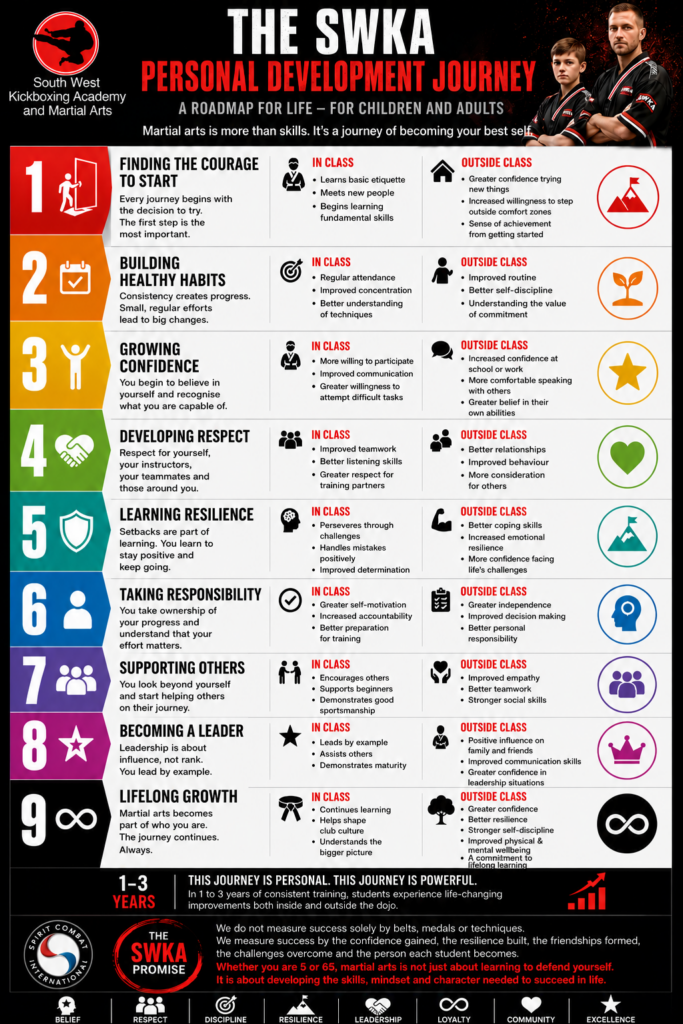
11. How Character Fits Into the SWKA 9-Stage Martial Arts Journey
At SWKA, we use our 9-Stage Martial Arts Journey to help students understand that martial arts development is about more than physical skills.
The journey begins with having the courage to start.
Then comes confidence.
Respect.
Discipline.
Resilience.
Community.
Responsibility.
Helping others.
And eventually the qualities represented by BLACK BELT.
These stages are connected.
For example, a student needs confidence to try something new.
But they also need humility to accept that they don’t know everything.
They need discipline to practise.
Resilience to overcome setbacks.
Respect to work with others.
And responsibility to use their developing abilities appropriately.
Our BLACK BELT philosophy brings these qualities together:
B – Belief
L – Leadership
A – Accountability
C – Commitment
K – Knowledge
B – Balance
E – Excellence
L – Learning
T – Tenacity
The belt represents progress.
But the person wearing it is the real achievement.
12. The Real Test Happens Outside the Training Hall
One of the most important questions we can ask is whether the lessons learned through martial arts influence how students behave elsewhere.
Does the child who shows respect in class also try to show respect at school?
Does the teenager who takes responsibility for their training begin taking more responsibility at home?
Does the adult who learns to accept corrections become more willing to receive feedback at work?
These changes aren’t automatic.
And martial arts isn’t the only activity that can help develop character.
But when instructors encourage students to think about how their actions affect others, training can become more than simply learning techniques.
It becomes an opportunity to practise qualities that matter in everyday life.
Because ultimately, character isn’t something we switch on when we put on a martial arts uniform.
It’s something we carry with us.
Character Building Through Martial Arts in Tavistock and Bere Alston
At South West Kickboxing Academy & Martial Arts, our aim is to help children, teenagers and adults develop their martial arts skills alongside positive personal qualities.
With 24 years of martial arts experience and teaching since 2005, I believe the long-term value of martial arts extends far beyond the techniques students learn.
Our regular classes include:
🥊 Mixed Age Kickboxing in Tavistock – ages 7+
🥋 Children’s Spirit Combat (Aiki-Jitsu) in Bere Alston
🥋 Adult Spirit Combat (Aiki-Jitsu) in Bere Alston – ages 14+
We welcome complete beginners and offer two trial classes.
Whether you’re looking for an activity to help your child develop confidence and responsibility, or you’re an adult looking for a new challenge, martial arts can provide opportunities for personal development over months and years.
A Final Thought
Imagine two students.
Both attend classes.
Both learn techniques.
Both achieve gradings.
But one only makes an effort when somebody is watching.
The other gradually learns to take responsibility for their own progress, support others and make positive choices without being reminded.
The difference isn’t necessarily their martial arts ability.
It’s their character.
And that’s why I believe one of the most important questions we can ask isn’t simply:
“What have I learned?”
It’s:
“Who am I becoming when nobody is watching?”
Because the real measure of character isn’t the belt around your waist.
It’s the choices you make when nobody is there to check.