Learning to Fail, Try Again and Succeed:

How Martial Arts Builds Self-Belief for Life

Nobody enjoys getting things wrong.

A child struggles with something at school and decides, “I’m no good at this.”

A teenager compares themselves with other people and feels they’re falling behind.

An adult thinks about trying something new but worries they’ll embarrass themselves.

So sometimes the easiest option becomes not trying at all.

But one of the most valuable lessons I’ve seen people learn through martial arts is very simple:

Getting something wrong doesn’t mean you can’t do it. It means you can’t do it yet.

After 24 years training in martial arts and teaching since 2005, I’ve watched this lesson change children, teenagers and adults.

And it doesn’t happen because we sit students down and give them a motivational speech.

It happens through what they experience in class, week after week.

Nobody Walks Into Their First Class Being Good at Martial Arts

This sounds obvious, but it’s important.

A beginner is supposed to be a beginner.

Their stance might feel strange.

They may struggle to remember which hand or foot they’re supposed to move.

Their balance might disappear halfway through a technique.

They might watch an experienced student and wonder how they’ll ever be able to do the same thing.

That’s normal.

The important part is what happens next.

We practise.

We break things down.

We repeat them.

An instructor helps.

A training partner helps.

And gradually something that initially felt impossible starts becoming possible.

That first experience teaches an incredibly valuable lesson:

Ability can change.

“I Can’t Do It” Becomes “I Can’t Do It Yet”

Imagine a child struggling with a new technique.

They try it.

It doesn’t work.

They try again.

Still not quite right.

Perhaps we simplify it.

Perhaps we practise one part before putting everything together.

Then suddenly they get it.

You can often see the moment it happens.

The expression changes.

They’ve proved something to themselves.

Nobody needed to tell them they were capable.

They now KNOW they’re capable because they’ve experienced it.

The next time something is difficult, they have evidence from the past:

“I struggled before and eventually did it.”

That’s where resilience begins.

Children Learn That Mistakes Aren’t Something to Fear

Children are constantly being measured.

School work.

Tests.

Sports.

Social groups.

Sometimes children become so worried about getting things wrong that they stop wanting to try.

Martial arts gives them repeated opportunities to make mistakes in a safe environment.

Forget a sequence?

Let’s try again.

Lose your balance?

Reset and go again.

Technique didn’t work?

Work out why.

The mistake isn’t the end of the activity.

It’s part of learning it.

Over months and years, that can change someone’s relationship with failure.

Instead of:

“I got it wrong, so I’m bad at it.”

It can become:

“I got it wrong. What do I need to change?”

That’s a very different mindset to carry into life.

Teenagers Learn Not to Compare Their Chapter One With Someone Else’s Chapter Ten

Comparison can be particularly difficult during the teenage years.

Someone is stronger.

Someone is more confident.

Someone learns faster.

Someone has a higher belt.

Outside martial arts, social media can amplify that comparison even further.

But martial arts teaches students that everybody is on their own journey.

The experienced student they’re watching may have been training for five years.

They didn’t arrive with those abilities.

They built them.

Class after class.

Month after month.

Year after year.

Instead of asking:

“Why aren’t I as good as them?”

The better question becomes:

“What could I become if I keep going?”

That’s a lesson that extends far beyond martial arts.

Adults Rediscover What It Feels Like to Be a Beginner

This is something I think adults particularly benefit from.

As we get older, we often become very good at staying inside our comfort zones.

We do the job we know.

Follow familiar routines.

Spend time with familiar people.

Then suddenly you walk into a martial arts class and you’re a beginner again.

You don’t know everything.

You make mistakes.

Someone younger than you might know considerably more than you do.

That can initially feel uncomfortable.

But it can also be incredibly freeing.

You realise you don’t have to be good at something immediately.

You’re allowed to learn.

You’re allowed to make mistakes.

You’re allowed to improve.

And every few months you can look backwards and realise how far you’ve come.

Gradings Give Progress a Purpose

Belts shouldn’t simply be pieces of material handed out for attendance.

They should represent progress.

Preparing for a grading gives students something to work towards.

There will normally be things they can already do confidently and other areas that need more practice.

That means setting a goal.

Working towards it.

Receiving feedback.

Improving.

Dealing with nerves.

And eventually demonstrating what they’ve learned.

The value isn’t simply receiving the next belt.

It’s experiencing the process required to earn it.

That’s why the journey matters more than the destination.

Confidence Comes From Evidence

We talk a lot about confidence in martial arts.

But genuine confidence isn’t:

“I’m amazing at everything.”

It’s:

“I don’t know whether I can do this yet, but I’m willing to try.”

That confidence is built from hundreds of experiences.

The technique you eventually mastered.

The first grading you were nervous about.

The first time you worked with somebody new.

The first time you demonstrated something.

The first time somebody asked YOU for help.

Each experience becomes another piece of evidence.

Over time:

“I don’t think I can”

starts becoming:

“I’ll give it a go.”

That’s transformation.

This Is Why Our 9-Stage Journey Takes Time

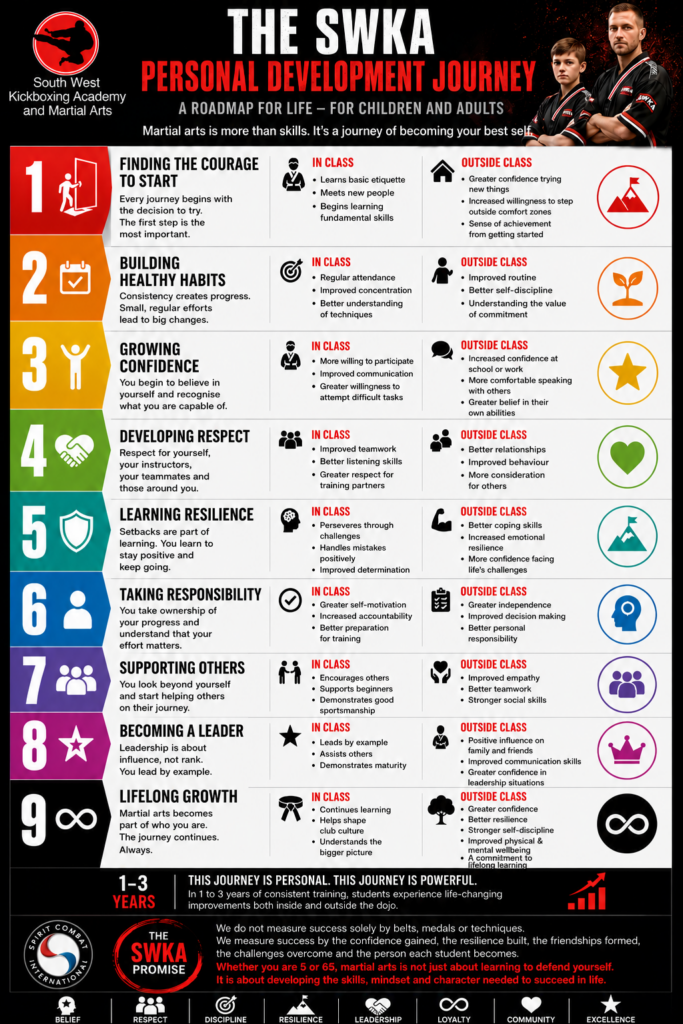
At SWKA, we’ve developed our 9-Stage Martial Arts Journey because we don’t believe martial arts should simply be about rushing students through belts.

The journey moves from being the nervous beginner towards developing confidence, respect, discipline and resilience.

Then something changes.

Students begin taking greater responsibility for themselves.

They start helping others.

They develop leadership.

Eventually, the person who once needed encouragement becomes the person encouraging somebody else.

You cannot manufacture that transformation in six weeks.

It requires experiences.

Challenges.

Mistakes.

Successes.

Friendships.

Responsibility.

And time.

Imagine the Difference After Several Years

Think about a child who spends several years regularly experiencing:

“I struggled, but I kept going.”

“I was nervous, but I did it.”

“I made a mistake, but I learned from it.”

“I didn’t know anyone, but I made friends.”

“I needed help, and somebody helped me.”

“Now somebody else needs help, and I can help them.”

Those aren’t simply martial arts lessons.

They’re life lessons.

Now imagine that child becoming a teenager carrying those experiences with them.

Or the adult who starts training believing they’re too old, too unfit or too nervous and several years later is helping a brand-new beginner.

That’s why the long-term value of martial arts can be so much greater than the techniques themselves.

What Could You Become If You Stopped Being Afraid of Getting Things Wrong?

Whether you’re 7, 17 or 47, starting something new can feel uncomfortable.

That’s okay.

You don’t need to arrive at martial arts confident.

You don’t need to be fit.

You don’t need previous experience.

You certainly don’t need to be good at it on your first night.

You just need to be willing to begin.

At SWKA, we offer:

  • Mixed Age Kickboxing in Tavistock for ages 7+
  • Children’s Spirit Combat (Aiki-Jitsu) in Bere Alston
  • Adult Spirit Combat (Aiki-Jitsu) in Bere Alston

Our goal isn’t to see how quickly somebody can collect belts.

It’s to help students progress through a journey where they become more confident, resilient, disciplined and capable over time.

Because one day the person saying:

“I don’t think I can do that.”

may become the person telling a nervous beginner:

“Don’t worry. I couldn’t do it when I started either.”

And that transformation is worth far more than any belt.

How Martial Arts Changes People:

What Actually Happens Over Months and Years of Training?

It is easy for a martial arts club to say:

“We build confidence.”

“We teach discipline.”

“We help people make friends.”

“We develop resilience.”

But how does that actually happen?

A child doesn’t walk into their first martial arts lesson lacking confidence and walk out an hour later transformed.

An adult doesn’t attend three classes and suddenly become fitter, more resilient and completely self-assured.

Real transformation doesn’t work like that.

After 24 years training in martial arts and teaching since 2005, I’ve found that the greatest changes happen through hundreds of small experiences repeated over months and years.

That is why at SWKA we don’t see martial arts as something you try for a few weeks before moving onto the next activity.

We see it as a journey.

And that journey begins with something very simple.

The Nervous Beginner Walks Through the Door

Imagine a child arriving for their first class.

They don’t know anybody.

They may stand close to Mum or Dad.

They watch the other students talking and wonder whether they’ll fit in.

An adult beginner can feel exactly the same.

They may be thinking:

“Everyone is going to be better than me.”

“I’m going to look stupid.”

“I’m not fit enough for this.”

The first achievement isn’t performing the perfect technique.

It’s walking through the door.

Then they join in.

Perhaps an instructor introduces them to another student.

They follow the warm-up.

They try a few basic techniques.

Someone helps them when they get confused.

They realise nobody is laughing at them.

Then the class finishes.

They did it.

That might seem like a tiny achievement.

But confidence is built from experiences exactly like this.

How Strangers Gradually Become Friends

We don’t sit students down and tell them:

“Tonight you’re going to make some friends.”

Friendships develop naturally through what happens during training.

Students work together.

One person holds equipment while another practises.

They swap roles.

They practise techniques together.

They make mistakes together.

They laugh.

They encourage each other.

The following week they see the same faces again.

“Hello.”

Another week passes.

They remember each other’s names.

Soon they’re choosing to work together.

Eventually they’re talking before the class even starts.

For children who find social situations difficult, this can be particularly valuable because they don’t necessarily have to think of something to say or work out how to join a friendship group.

They already have a shared activity.

For teenagers, martial arts can provide friendships outside their normal school environment.

For adults, it creates something many people gradually lose as life becomes dominated by work and responsibilities:

Regular opportunities to meet people.

After months of training, the room that once contained a group of strangers can become somewhere you genuinely feel you belong.

How Confidence Is Actually Built

We often hear people say they want themselves or their child to become more confident.

But confidence can’t simply be given to somebody.

Telling someone:

“You’re brilliant.”

may feel good temporarily.

Real confidence comes from evidence.

A student struggles with a technique.

They practise it.

They still can’t quite get it.

Someone helps them.

They try again.

Then one evening it works.

That creates evidence:

“I couldn’t do that before. Now I can.”

Later they prepare for a grading.

They’re nervous.

They complete it.

More evidence:

“I can do difficult things even when I’m nervous.”

Months later, an instructor asks them to demonstrate something.

The person who once wanted to disappear at the back of the room stands in front of everyone.

More evidence.

This is how confidence develops.

Not through one dramatic moment, but through hundreds of small achievements.

How Resilience Develops Without Students Realising It

Martial arts doesn’t always go perfectly.

Sometimes a technique is difficult.

Sometimes someone forgets something they knew last week.

Sometimes a grading doesn’t go as well as hoped.

Sometimes another student progresses faster.

These experiences create opportunities to learn something incredibly important:

Difficulty doesn’t mean stop.

We try again.

Perhaps we break the technique into smaller parts.

Perhaps an instructor explains it differently.

Perhaps a training partner helps.

Eventually progress happens.

A child who experiences that repeatedly starts learning:

“I don’t have to give up just because something is difficult.”

A teenager learns that mistakes aren’t embarrassing; they’re part of learning.

An adult who may have avoided challenging themselves for years begins deliberately choosing challenges again.

That’s resilience being developed in real time.

Discipline Starts With Simply Turning Up

Discipline in martial arts isn’t about instructors shouting at people.

It starts with consistency.

It’s raining.

You’ve had a long day.

The sofa looks appealing.

But you go training anyway.

Children gradually learn that progress requires regular attendance.

Teenagers begin taking greater responsibility for remembering equipment and preparing for gradings.

Adults start protecting that hour in their week because they know how much better they feel afterwards.

One class becomes ten.

Ten becomes fifty.

Eventually training becomes part of who you are.

That same understanding — that results come from consistent action — can carry into education, work, fitness and everyday life.

Students Gradually Become More Active

Someone doesn’t need to become fit before starting martial arts.

Fitness develops through participating.

A beginner may initially find the warm-up challenging.

That’s okay.

Over time they keep moving for longer.

Their coordination improves.

Techniques become smoother.

Their balance develops.

They become stronger.

Children spend an hour moving rather than sitting behind a screen.

Teenagers have somewhere positive to use their energy.

Adults who may spend much of their working day sitting suddenly have a reason to move, stretch, learn and challenge themselves.

And because there’s always another technique or skill to learn, exercise has a purpose beyond simply burning calories.

Neurodiverse Students Don’t Have to Fit One Mould

People don’t all learn in the same way.

Some students understand something immediately after seeing it demonstrated.

Others need to practise it several times.

Some enjoy working with lots of different people.

Others initially prefer familiar training partners.

Some students are comfortable speaking in front of the group.

Others need months before they’re ready.

Martial arts can provide structure without expecting everybody to have exactly the same personality.

There is a routine.

There are clear goals.

Techniques can be broken into smaller stages.

Progress can happen through repetition.

A student doesn’t have to become the loudest person in the room to succeed.

The goal is progress from their own starting point.

Over time, that can mean increased confidence, greater independence and feeling more comfortable as part of the group.

Then Something Important Starts Happening

After months or years, the student isn’t the beginner anymore.

Someone new walks through the door.

They’re nervous.

They’re standing quietly.

They don’t know anybody.

And one of our existing students says hello.

They offer to work with them.

They explain something they’re struggling with.

They reassure them.

The person who once needed help has become the person giving it.

That’s a major stage in our 9-Stage Martial Arts Journey.

Students aren’t simply collecting techniques and belts.

They’re developing responsibility and leadership.

Eventually they begin understanding that their behaviour affects the people around them.

They become examples for newer students.

For a parent who remembers the nervous child they originally brought through the door, that transformation can be enormous.

What Happens After Several Years?

This is where the real value of long-term martial arts training becomes clear.

Imagine hundreds of experiences involving:

Trying something difficult.

Getting it wrong.

Trying again.

Working with different people.

Learning to communicate.

Helping others.

Being helped.

Preparing for gradings.

Dealing with nerves.

Achieving goals.

Showing respect.

Taking responsibility.

Learning self-control.

Becoming physically more capable.

Eventually those aren’t simply things somebody does at martial arts.

They start becoming qualities within the person.

Confidence.

Resilience.

Discipline.

Respect.

Self-belief.

Responsibility.

Leadership.

Belonging.

That’s why our 9-Stage Martial Arts Journey isn’t designed around getting somebody through a few weeks of classes.

We’re looking at where martial arts could take that person over the coming years.

The Black Belt Isn’t the Real Transformation

People naturally associate martial arts with earning a black belt.

And achieving one is something to be proud of.

But the piece of material around someone’s waist isn’t really the transformation.

The transformation is everything that happened while earning it.

The nervous beginner who learned to believe in themselves.

The shy child who learned to work with others.

The teenager who developed resilience and responsibility.

The adult who became fitter, more confident and discovered something they genuinely enjoyed.

The student who eventually became a role model for somebody else.

That’s what the journey represents.

What Could Change Over the Next Few Years?

If you’re considering martial arts for yourself or your child, don’t only ask:

“What will we do in the first class?”

Ask a bigger question.

“Who could I — or my child — become after two or three years of doing this?”

At SWKA, we offer:

  • Mixed Age Kickboxing in Tavistock for ages 7+
  • Children’s Spirit Combat (Aiki-Jitsu) in Bere Alston
  • Adult Spirit Combat (Aiki-Jitsu) in Bere Alston

Complete beginners are welcome.

You don’t need confidence before starting.

You don’t need friends already in the class.

You don’t need to be fit.

Those can all become part of the journey.

The first few weeks introduce you to martial arts.

The months and years that follow are where the real transformation happens.

If you’d like to discover where that journey could take you or your child, get in touch with SWKA and come along for two trial classes.
You may arrive simply wanting to try martial arts.

You might eventually discover you’re capable of far more than you expected.

Sparring Kit

We are pleased to announced we have finally put together a sparring kit package for students. Which benefits students sparring in class and also kit needed for competition. Currently student without any safety equipment end up borrowing from coaches and when classes are busy their isn’t enough kit to go round. So we have finally sorting out a kit package so students dont need to keep swapping kit on fight days.

Kit includes

1xbag

1x male/female groin guard

1x boxing gloves

1x head guard

1x shin guards

1x foot boots

1x gum shield

Price £95.00, if you have your own gloves already for the rest of the equipment price is £75.00.

Please speak to Steve or Matt to book your sparring kit.

Why Martial Arts Teaches Discipline Without Being Strict

When some people hear the word discipline, they immediately think of punishment, shouting, or being told off.

In reality, true discipline is something very different.

After 24 years training in martial arts and teaching since 2005, I’ve come to believe that discipline is one of the greatest gifts martial arts can give both children and adults.

Not because it teaches people to follow orders.

But because it teaches them to make positive choices, even when those choices aren’t always the easiest.

That is a skill that benefits every area of life.

Discipline Is About Habits, Not Punishment

The word discipline often has negative associations.

In martial arts, discipline isn’t about being perfect.

It’s about creating positive habits.

Turning up when you said you would.

Listening when someone is speaking.

Treating others with respect.

Giving your best effort.

Learning from mistakes instead of giving up.

These habits don’t just help someone become a better martial artist.

They help them become a more confident and capable person.

What Children Learn

Parents often tell us they aren’t looking for another activity simply to keep their child busy.

They’re looking for something that helps prepare them for life.

Through regular training, children begin learning the importance of:

  • Arriving prepared.
  • Listening carefully.
  • Following instructions.
  • Working with others.
  • Showing respect.
  • Trying again when something feels difficult.

These are skills that can support them at school, at home and in future careers.

Children don’t become disciplined overnight.

Like any worthwhile skill, it develops over time through regular practice.

Teenagers Discover Responsibility

The teenage years are often a time of increasing independence.

With that independence comes responsibility.

Martial arts helps teenagers understand that progress comes from consistent effort.

If they want to improve a technique, they practise.

If they want to earn their next belt, they commit to training.

If they make a mistake, they learn from it.

These lessons encourage accountability rather than excuses.

That mindset can help teenagers both inside and outside the training hall.

Adults Benefit Too

Many adults start martial arts to improve their fitness.

What often surprises them is how much they enjoy having a regular routine again.

One class each week becomes:

  • Time away from work.
  • Time away from screens.
  • Time to focus on themselves.
  • Time to keep improving.

Over months and years, that consistency often spreads into other areas of life.

People become more active.

More organised.

More resilient.

More confident.

Discipline isn’t something forced upon them.

It becomes something they choose because they experience the benefits.

Small Habits Create Big Results

One martial arts lesson might not seem like much.

But one lesson every week becomes:

Around 50 lessons in a year.

Hundreds of hours over several years.

Thousands of opportunities to learn, improve and grow.

This is why we talk about the 9-Stage Martial Arts Journey at SWKA.

The journey isn’t about rushing to a black belt.

It’s about becoming a little better every week.

Those small improvements soon become major changes.

Discipline Builds Confidence

People often think confidence comes first.

In reality, confidence usually follows discipline.

A student who keeps turning up begins to improve.

As they improve, they achieve more.

As they achieve more, confidence grows.

The confidence isn’t based on luck.

It’s based on knowing they earned it.

That confidence often transfers into school, work, relationships and everyday life.

The Lessons Continue Beyond the Mats

One of the most rewarding parts of teaching martial arts is seeing students use these lessons elsewhere.

A child becomes more willing to try new things at school.

A teenager approaches exams with greater confidence.

An adult starts believing they can achieve goals they once thought impossible.

The physical techniques remain important.

But the habits developed through training often become even more valuable.

A Journey That Lasts for Years

Martial arts isn’t about becoming perfect.

It’s about continually learning.

Every class provides another opportunity to:

  • Improve.
  • Learn.
  • Help others.
  • Build confidence.
  • Develop resilience.
  • Strengthen discipline.

These qualities don’t appear overnight.

They are built through months and years of consistent training.

That is why the greatest reward isn’t simply earning a new belt.

It’s becoming a stronger version of yourself.

Start Building Positive Habits Today

Whether you’re looking for an activity that helps your child develop confidence and discipline, you’re a teenager wanting a new challenge, or you’re an adult ready to improve your fitness and wellbeing, martial arts offers far more than physical techniques.

At SWKA, we support every student through their own personal journey, helping them develop skills that benefit them both inside and outside the training hall.

We offer:

  • Mixed Age Kickboxing Classes in Tavistock (Ages 7+)
  • Children’s Spirit Combat (Aiki-Jitsu) Classes in Bere Alston
  • Adult Spirit Combat (Aiki-Jitsu) Classes in Bere Alston

The goal isn’t simply to become better at martial arts.

The goal is to become more confident, more resilient, more disciplined and more capable in everyday life.

If you’re ready to begin your own journey, we’d love to welcome you to SWKA.

Your future is built by the habits you create today. Why not make martial arts one of them?