How Martial Arts Changes People:
What Actually Happens Over Months and Years of Training?
It is easy for a martial arts club to say:
“We build confidence.”
“We teach discipline.”
“We help people make friends.”
“We develop resilience.”
But how does that actually happen?
A child doesn’t walk into their first martial arts lesson lacking confidence and walk out an hour later transformed.
An adult doesn’t attend three classes and suddenly become fitter, more resilient and completely self-assured.
Real transformation doesn’t work like that.
After 24 years training in martial arts and teaching since 2005, I’ve found that the greatest changes happen through hundreds of small experiences repeated over months and years.
That is why at SWKA we don’t see martial arts as something you try for a few weeks before moving onto the next activity.
We see it as a journey.
And that journey begins with something very simple.
The Nervous Beginner Walks Through the Door
Imagine a child arriving for their first class.
They don’t know anybody.
They may stand close to Mum or Dad.
They watch the other students talking and wonder whether they’ll fit in.
An adult beginner can feel exactly the same.
They may be thinking:
“Everyone is going to be better than me.”
“I’m going to look stupid.”
“I’m not fit enough for this.”
The first achievement isn’t performing the perfect technique.
It’s walking through the door.
Then they join in.
Perhaps an instructor introduces them to another student.
They follow the warm-up.
They try a few basic techniques.
Someone helps them when they get confused.
They realise nobody is laughing at them.
Then the class finishes.
They did it.
That might seem like a tiny achievement.
But confidence is built from experiences exactly like this.
How Strangers Gradually Become Friends
We don’t sit students down and tell them:
“Tonight you’re going to make some friends.”
Friendships develop naturally through what happens during training.
Students work together.
One person holds equipment while another practises.
They swap roles.
They practise techniques together.
They make mistakes together.
They laugh.
They encourage each other.
The following week they see the same faces again.
“Hello.”
Another week passes.
They remember each other’s names.
Soon they’re choosing to work together.
Eventually they’re talking before the class even starts.
For children who find social situations difficult, this can be particularly valuable because they don’t necessarily have to think of something to say or work out how to join a friendship group.
They already have a shared activity.
For teenagers, martial arts can provide friendships outside their normal school environment.
For adults, it creates something many people gradually lose as life becomes dominated by work and responsibilities:
Regular opportunities to meet people.
After months of training, the room that once contained a group of strangers can become somewhere you genuinely feel you belong.
How Confidence Is Actually Built
We often hear people say they want themselves or their child to become more confident.
But confidence can’t simply be given to somebody.
Telling someone:
“You’re brilliant.”
may feel good temporarily.
Real confidence comes from evidence.
A student struggles with a technique.
They practise it.
They still can’t quite get it.
Someone helps them.
They try again.
Then one evening it works.
That creates evidence:
“I couldn’t do that before. Now I can.”
Later they prepare for a grading.
They’re nervous.
They complete it.
More evidence:
“I can do difficult things even when I’m nervous.”
Months later, an instructor asks them to demonstrate something.
The person who once wanted to disappear at the back of the room stands in front of everyone.
More evidence.
This is how confidence develops.
Not through one dramatic moment, but through hundreds of small achievements.
How Resilience Develops Without Students Realising It
Martial arts doesn’t always go perfectly.
Sometimes a technique is difficult.
Sometimes someone forgets something they knew last week.
Sometimes a grading doesn’t go as well as hoped.
Sometimes another student progresses faster.
These experiences create opportunities to learn something incredibly important:
Difficulty doesn’t mean stop.
We try again.
Perhaps we break the technique into smaller parts.
Perhaps an instructor explains it differently.
Perhaps a training partner helps.
Eventually progress happens.
A child who experiences that repeatedly starts learning:
“I don’t have to give up just because something is difficult.”
A teenager learns that mistakes aren’t embarrassing; they’re part of learning.
An adult who may have avoided challenging themselves for years begins deliberately choosing challenges again.
That’s resilience being developed in real time.
Discipline Starts With Simply Turning Up
Discipline in martial arts isn’t about instructors shouting at people.
It starts with consistency.
It’s raining.
You’ve had a long day.
The sofa looks appealing.
But you go training anyway.
Children gradually learn that progress requires regular attendance.
Teenagers begin taking greater responsibility for remembering equipment and preparing for gradings.
Adults start protecting that hour in their week because they know how much better they feel afterwards.
One class becomes ten.
Ten becomes fifty.
Eventually training becomes part of who you are.
That same understanding — that results come from consistent action — can carry into education, work, fitness and everyday life.
Students Gradually Become More Active
Someone doesn’t need to become fit before starting martial arts.
Fitness develops through participating.
A beginner may initially find the warm-up challenging.
That’s okay.
Over time they keep moving for longer.
Their coordination improves.
Techniques become smoother.
Their balance develops.
They become stronger.
Children spend an hour moving rather than sitting behind a screen.
Teenagers have somewhere positive to use their energy.
Adults who may spend much of their working day sitting suddenly have a reason to move, stretch, learn and challenge themselves.
And because there’s always another technique or skill to learn, exercise has a purpose beyond simply burning calories.
Neurodiverse Students Don’t Have to Fit One Mould
People don’t all learn in the same way.
Some students understand something immediately after seeing it demonstrated.
Others need to practise it several times.
Some enjoy working with lots of different people.
Others initially prefer familiar training partners.
Some students are comfortable speaking in front of the group.
Others need months before they’re ready.
Martial arts can provide structure without expecting everybody to have exactly the same personality.
There is a routine.
There are clear goals.
Techniques can be broken into smaller stages.
Progress can happen through repetition.
A student doesn’t have to become the loudest person in the room to succeed.
The goal is progress from their own starting point.
Over time, that can mean increased confidence, greater independence and feeling more comfortable as part of the group.
Then Something Important Starts Happening
After months or years, the student isn’t the beginner anymore.
Someone new walks through the door.
They’re nervous.
They’re standing quietly.
They don’t know anybody.
And one of our existing students says hello.
They offer to work with them.
They explain something they’re struggling with.
They reassure them.
The person who once needed help has become the person giving it.
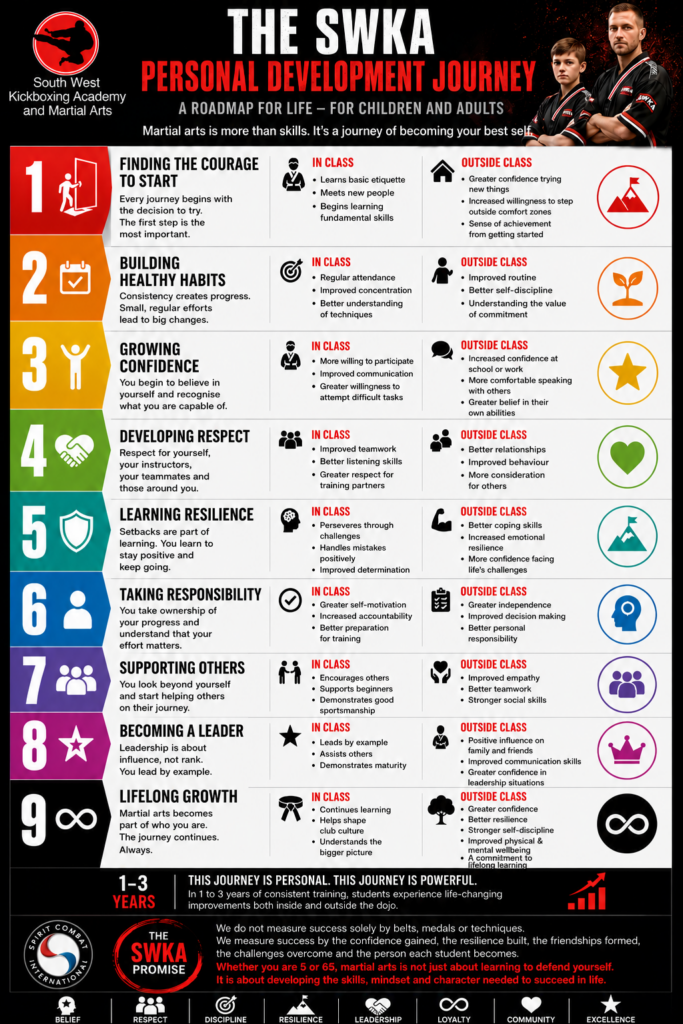
That’s a major stage in our 9-Stage Martial Arts Journey.
Students aren’t simply collecting techniques and belts.
They’re developing responsibility and leadership.
Eventually they begin understanding that their behaviour affects the people around them.
They become examples for newer students.
For a parent who remembers the nervous child they originally brought through the door, that transformation can be enormous.
What Happens After Several Years?
This is where the real value of long-term martial arts training becomes clear.
Imagine hundreds of experiences involving:
Trying something difficult.
Getting it wrong.
Trying again.
Working with different people.
Learning to communicate.
Helping others.
Being helped.
Preparing for gradings.
Dealing with nerves.
Achieving goals.
Showing respect.
Taking responsibility.
Learning self-control.
Becoming physically more capable.
Eventually those aren’t simply things somebody does at martial arts.
They start becoming qualities within the person.
Confidence.
Resilience.
Discipline.
Respect.
Self-belief.
Responsibility.
Leadership.
Belonging.
That’s why our 9-Stage Martial Arts Journey isn’t designed around getting somebody through a few weeks of classes.
We’re looking at where martial arts could take that person over the coming years.
The Black Belt Isn’t the Real Transformation
People naturally associate martial arts with earning a black belt.
And achieving one is something to be proud of.
But the piece of material around someone’s waist isn’t really the transformation.
The transformation is everything that happened while earning it.
The nervous beginner who learned to believe in themselves.
The shy child who learned to work with others.
The teenager who developed resilience and responsibility.
The adult who became fitter, more confident and discovered something they genuinely enjoyed.
The student who eventually became a role model for somebody else.
That’s what the journey represents.
What Could Change Over the Next Few Years?
If you’re considering martial arts for yourself or your child, don’t only ask:
“What will we do in the first class?”
Ask a bigger question.
“Who could I — or my child — become after two or three years of doing this?”
At SWKA, we offer:
- Mixed Age Kickboxing in Tavistock for ages 7+
- Children’s Spirit Combat (Aiki-Jitsu) in Bere Alston
- Adult Spirit Combat (Aiki-Jitsu) in Bere Alston
Complete beginners are welcome.
You don’t need confidence before starting.
You don’t need friends already in the class.
You don’t need to be fit.
Those can all become part of the journey.
The first few weeks introduce you to martial arts.
The months and years that follow are where the real transformation happens.
If you’d like to discover where that journey could take you or your child, get in touch with SWKA and come along for two trial classes.
You may arrive simply wanting to try martial arts.
You might eventually discover you’re capable of far more than you expected.